
Have you ever had a book idea that sounded great in your head, started writing it, and then wondered:
“Will anyone actually want to buy this book?”
That’s an important question to ask before you spend weeks writing.
Publishing on Amazon KDP makes it relatively easy to turn an idea into a book. But easy publishing doesn’t mean every book idea has a viable audience.
A better approach is to validate the idea before writing the manuscript.
Book idea validation doesn’t mean trying to predict exactly how many copies you’ll sell.
If you’re still deciding which KDP niche to enter, start with our guide on how to choose a profitable KDP niche in 2026 before validating your specific book idea.
Instead, you’re looking for evidence.
You want to know:
- Is there a clearly defined audience?
- Does the reader have a problem or desire?
- Are people already buying books around the subject?
- What competing books exist?
- What do readers like and dislike about those books?
- Can you offer a meaningful difference?
- Can the idea support a professional product?
- Could the concept potentially become part of a larger publishing strategy?
This guide walks through a practical process you can use before committing to your next Amazon KDP book.
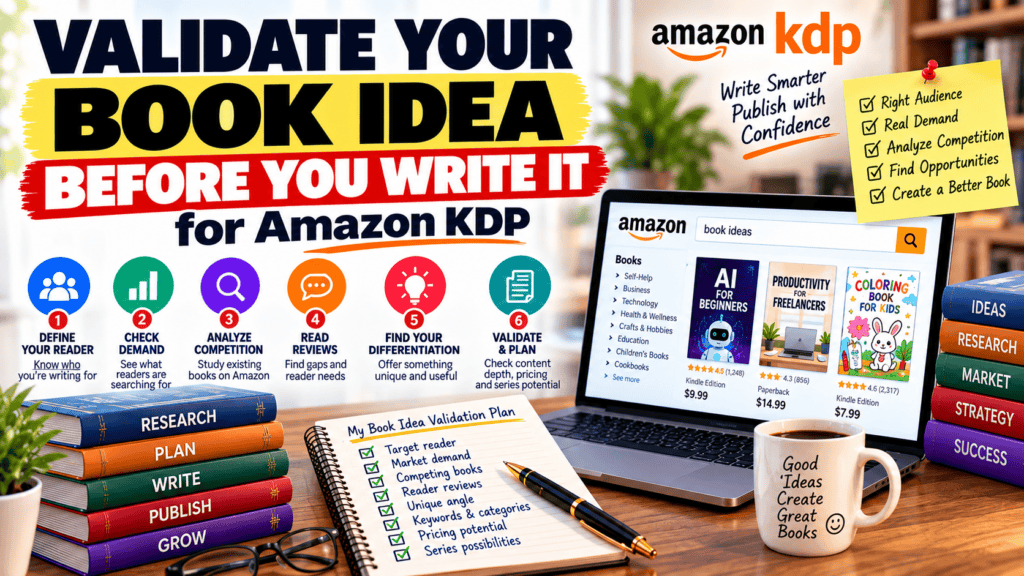
Table of Contents
What Does It Mean to Validate a Book Idea?
Book idea validation is the process of researching a potential book before writing it to determine whether there is enough evidence of reader interest and whether you can create a useful, differentiated product.
It is not a guarantee of sales.
No research method can guarantee that a book will become successful.
Instead, validation reduces unnecessary guesswork.
Think of it as a pre-writing checkpoint:
Idea → Research → Validation → Book concept → Writing
rather than:
Idea → 200 pages → Publish → Hope
That small change in workflow can save a tremendous amount of time.
Why Validate Your KDP Book Idea Before Writing?
Writing a book requires more than producing words.
Depending on the project, you may also spend time on:
- Research
- Outlining
- Writing
- Editing
- Cover design
- Formatting
- Metadata
- Publishing
- Marketing
- Promotion
If the underlying concept isn’t clearly positioned, all of that work becomes harder.
Validation helps you answer an important question:
“Is this the right idea to invest my time in?”
It can also help you improve the idea before you write the first chapter.
Step 1: Define Your Target Reader
The first question isn’t:
“What should my book be about?”
It’s:
“Who is this book for?”
Consider these two ideas.
Idea A
A book about artificial intelligence.
Idea B
A practical AI guide for freelance writers who want to use ChatGPT to save time on research, content planning, and client communication.
Idea B gives you a much clearer audience.
You know:
- Who the reader is
- What they do
- What technology they’re interested in
- What problem they’re trying to solve
That makes validation much easier.
Use this formula
Specific audience + specific problem + desired outcome
For example:
Beginner freelancers + difficulty managing multiple clients + want a simpler workflow.
Potential book:
AI Productivity for Freelancers
Now you have something specific to research.
Step 2: Identify the Problem Behind the Idea
A book can be based on entertainment, education, inspiration, hobbies, or practical problem-solving.
For nonfiction especially, it’s useful to understand the underlying reader motivation.
Ask:
Why would someone spend money on this book?
Possible reasons include:
- They want to learn something.
- They want to solve a problem.
- They want to save time.
- They want to make money.
- They want to develop a skill.
- They want entertainment.
- They want a structured activity.
- They want guidance through a process.
- They want to achieve a particular outcome.
For example:
Topic: Gardening
That’s broad.
But:
How to Grow Vegetables on a Small Apartment Balcony
has a clearer problem and audience.
The second idea gives you a stronger foundation for research.
Step 3: Search Amazon for Similar Books
Now it’s time to research the marketplace.
Take your idea and search Amazon using several variations.
Don’t just search one phrase.
For example, if your idea is:
ChatGPT for Freelancers
try variations such as:
- ChatGPT for freelancers
- AI for freelancers
- AI productivity for freelancers
- ChatGPT freelance business
- AI tools for freelancers
- AI prompts for freelancers
Study the books that appear.
As you research competing books, it’s also useful to understand how Amazon’s category system works. Our guide to [Amazon KDP categories] explains how categories can affect your book’s positioning.
Look at:
- Titles
- Subtitles
- Covers
- Prices
- Formats
- Reviews
- Publication dates
- Categories
- Book lengths
- Series information
The purpose isn’t to copy successful books.
It’s to understand the market you’re considering entering.
Amazon’s own guidance recommends researching similar books and choosing categories based on relevance and reader interest.
Step 4: Don’t Run Away From Competition
One of the most common beginner mistakes is thinking:
“I need a niche with no competition.”
Not necessarily.
A market with no competing books may have very little demand.
Existing books can provide useful evidence that other publishers have identified an audience.
The better question is:
“Can I identify an audience here, and can I create something meaningfully different?”
You’re looking for a combination of:
Demand + understandable competition + differentiation opportunity
rather than zero competition.
Step 5: Study Competitor Reviews
This is one of the most valuable validation techniques.
Don’t just look at the covers and titles.
Read the reviews.
Pay particular attention to 2-star, 3-star, and 4-star reviews.
Why?
Because these reviews can reveal what existing books are missing.
You might discover comments such as:
- “Too advanced.”
- “Not enough examples.”
- “The information is outdated.”
- “Too much theory.”
- “The book is difficult to follow.”
- “I wanted more practical exercises.”
- “The chapters were repetitive.”
- “This was too basic.”
Don’t treat every review as objective truth.
But when the same complaint appears repeatedly, it can reveal an opportunity.
Step 6: Find Your Differentiation
Once you understand the existing books, ask:
Why should my version exist?
You don’t necessarily need a completely new subject.
Your differentiation might be:
Audience
Instead of:
AI for Business
Create:
AI for Small Business Owners
Experience level
Instead of:
Advanced AI Automation
Create:
AI Automation for Complete Beginners
Format
Instead of:
Traditional Guide
Create:
Step-by-Step Workbook
Application
Instead of:
ChatGPT Guide
Create:
ChatGPT for Real Estate Agents
Outcome
Instead of:
Productivity
Create:
A Practical Productivity System for Remote Freelancers
The difference is positioning.
Step 7: Check Whether the Topic Is Large Enough
Some ideas sound interesting but don’t contain enough material for a useful book.
Ask:
Can this topic support a complete reader experience?
For a nonfiction guide, consider:
- How many meaningful subtopics exist?
- Can you provide examples?
- Are there common questions?
- Are there practical exercises?
- Can you organize the subject logically?
- Can the reader achieve a useful outcome?
A book shouldn’t become 200 pages simply because you decided it must be 200 pages.
Depth and usefulness matter more than arbitrary length.
Step 8: Check Search Language
Once you have a promising concept, research how readers describe it.
This is where keyword research becomes useful.
For example, your internal concept may be:
“AI-powered productivity system for independent professionals.”
But readers may search:
“AI productivity for freelancers”
Those aren’t necessarily the same phrase.
Search Amazon and observe the suggestions that appear when entering your main topic.
Amazon specifically recommends thinking like a reader when selecting keywords and testing potential keywords on Amazon’s search field. KDP currently allows up to seven keywords or short phrases for a book.
For a deeper process, see:
Amazon KDP Keyword Research: The Complete Guide for Self-Publishers (2026)]
Step 9: Check Categories and Positioning
Your idea should also have a logical place in Amazon’s bookstore.
Ask:
Where would a reader expect to find this book?
For example:
A book about:
AI productivity for freelancers
could potentially intersect with subjects such as:
- Business
- Technology
- Productivity
- Entrepreneurship
The exact categories depend on the book’s actual content and the marketplace.
Don’t select unrelated categories simply because they appear easier to compete in.
Amazon states that categories should accurately describe the book and recommends balancing popularity with relevance
Once your topic, keywords, and categories are clear, you can use them to build a stronger overall [Amazon KDP SEO strategy]
Step 10: Evaluate the Commercial Model
Before writing, think about the economics.
Ask:
What format makes sense?
- Kindle ebook?
- Paperback?
- Hardcover?
- Workbook?
- Activity book?
What production effort is required?
- Research
- Writing
- Editing
- Design
- Formatting
What price range makes sense for comparable books?
Can the final product provide enough value for that price?
The goal isn’t to find a guaranteed price.
You’re trying to determine whether the product makes commercial sense before investing heavily in production.
Step 11: Check the Series Potential
Here’s a powerful question:
“If this book works, what could I publish next?”
Suppose your first idea is:
AI for Freelancers
Potential follow-up books:
- AI for Freelancers
- ChatGPT Prompts for Freelancers
- AI Productivity for Freelancers
- AI Marketing for Freelancers
- AI Client Communication
- AI Tools for Freelance Writers
Now the original book isn’t an isolated product.
It can potentially become part of a focused catalog.
A focused catalog can eventually become part of a larger [Amazon KDP publishing business].
This is one reason niche validation and book validation are related but different.
Your niche tells you where you’re playing.
Your book idea tells you what product you’re creating.
Step 12: Build a One-Sentence Book Concept
Before you start writing, complete this sentence:
This book helps [specific audience] achieve [specific outcome] by [specific method].
For example:
This book helps beginner freelancers save time by using practical ChatGPT workflows for everyday client work.
If you can’t explain your book clearly in one sentence, your concept may still be too broad.
Another useful formula is:
For [audience], who struggle with [problem], this book provides [solution] so they can [outcome].
This sentence can later help you develop:
- Your subtitle
- Book description
- Cover messaging
- Marketing content
- Website content
- Social media posts
The 15-Minute KDP Book Idea Validation Test
Before writing, complete this checklist.
Audience
☐ Can I clearly identify the reader?
☐ Do I understand what they want?
☐ Do they have a specific problem or interest?
Market
☐ Are there similar books on Amazon?
☐ Are readers discussing this topic?
☐ Can I identify related searches?
Competition
☐ Have I studied at least 10 competing books?
☐ Have I read some competitor reviews?
☐ Do I understand what existing books offer?
Differentiation
☐ Can I explain why my book is different?
☐ Can I serve a more specific audience?
☐ Can I improve on an identified weakness?
Product
☐ Is the format appropriate?
☐ Is there enough substance for a useful book?
☐ Can I produce it professionally?
Business
☐ Does the idea have reasonable pricing potential?
☐ Could it become part of a series?
☐ Could it lead to related products or content?
If you can answer most of these questions confidently, your idea deserves deeper development.
A Simple KDP Book Idea Scorecard
You can also score your idea before writing.
Give each category a score from 1 to 5.
| Validation Factor | Score |
|---|---|
| Audience clarity | /5 |
| Reader problem or desire | /5 |
| Existing market evidence | /5 |
| Competition understanding | /5 |
| Differentiation opportunity | /5 |
| Search potential | /5 |
| Content depth | /5 |
| Pricing potential | /5 |
| Series potential | /5 |
| Your ability to create quality | /5 |
| Total | /50 |
This isn’t an Amazon ranking formula.
It’s simply a framework for comparing your own ideas.
A low score doesn’t automatically mean the idea is bad.
It tells you where more research may be needed.
Book Idea Validation vs. Niche Research
These are easy to confuse.
Niche Research
Asks:
What market should I enter?
Example:
AI for freelancers
Book Idea Validation
Asks:
Is this specific product worth creating for that market?
Example:
ChatGPT Prompts for Freelancers: 300 Practical Prompts for Client Work, Marketing and Productivity
The first establishes the market.
The second validates the product.
That’s why these should be separate steps in your KDP workflow.
What About Using AI to Validate a Book Idea?
AI can be extremely useful during the research process.
If you’re using AI throughout the writing and publishing workflow, see our guide to the [best AI writing tools for KDP authors].
You can use it to:
- Brainstorm variations of an idea
- Identify potential audiences
- Generate research questions
- Organize competitor information
- Analyze reader-review themes
- Develop possible book structures
- Compare positioning angles
- Create research checklists
But don’t ask AI:
“Will this book definitely sell?”
There is no reliable prompt that can guarantee that answer.
Instead, use AI to help you organize evidence and think through possibilities, while using real marketplace research to make your decision.
Don’t Copy the Competition
Competitor research is for understanding the market—not reproducing another author’s book.
Avoid copying:
- Titles
- Subtitles
- Descriptions
- Chapters
- Unique frameworks
- Cover designs
- Copyrighted text
- Another author’s distinctive branding
Amazon’s current guidelines require book metadata to accurately represent the book and prohibit misleading or manipulative metadata.
Your goal should be:
Study the market → identify the gap → create your own product.
What If My Book Idea Is Already Covered?
That’s normal.
Very few commercial subjects are completely untouched.
If you find several competing books, don’t immediately abandon the idea.
Instead ask:
Can I make it more specific?
For example:
Broad
AI for Business
Narrower
AI for Small Business Owners
More specific
ChatGPT for Small Business Marketing
Even more targeted
ChatGPT Marketing for Local Service Businesses
The goal isn’t necessarily to invent a topic nobody has ever written about.
It’s to find a specific reader and a clear reason for your book to exist.
What If I Find Almost No Competition?
Be careful here.
Low competition sounds attractive.
But extremely low competition can mean several things:
- The topic is new.
- The market is underserved.
- The topic is difficult to discover.
- There isn’t much reader demand.
- The idea needs better positioning.
That’s why competition alone should never be your validation metric.
You need multiple signals.
When Should You Stop Researching and Start Writing?
This is important because research can become procrastination.
You don’t need perfect certainty.
Once you have:
- A defined reader
- A clear problem or purpose
- Evidence of market interest
- An understanding of competitors
- A differentiation strategy
- A workable product format
- A realistic publishing plan
you can move forward.
The goal of validation is not to eliminate uncertainty.
It’s to reduce avoidable uncertainty before you invest heavily.
Your KDP Idea Validation Workflow
Here’s the complete process:
1. Generate the idea
↓
2. Define the reader
↓
3. Identify the problem or desire
↓
4. Search Amazon
↓
5. Study competing books
↓
6. Read competitor reviews
↓
7. Identify gaps
↓
8. Research search language
↓
9. Check categories
↓
10. Decide your differentiation
↓
11. Evaluate format and economics
↓
12. Check series potential
↓
13. Write the one-sentence concept
↓
14. Score the idea
↓
15. Start the manuscript
This process is much more efficient than writing first and researching afterward.
Product Recommendation: Turn Your Validated Idea Into a Book
Once you’ve validated your concept, the next challenge is turning it into a properly structured, formatted, and published KDP book.
From Idea to Income — The Complete KDP Self-Publishing Guide
Have a book idea but don’t know what to do next?
Follow the complete journey from book idea to Amazon KDP publication.
Final Thoughts
A book idea doesn’t need to be completely original to be worth publishing.
It needs to have a clear reader, a meaningful purpose, a realistic market, and a reason for your version to exist.
Before writing your next manuscript, take a step back.
Ask:
Who is this book for?
Then:
What does this reader want?
Then:
What already exists?
And finally:
What can I create that is genuinely useful and meaningfully different?
That’s the foundation of smart KDP publishing.
Don’t try to predict the future perfectly.
Research first. Validate the idea. Then write the book.
Frequently Asked Questions
How do I know if my book idea is good?
A good book idea usually has a clearly identifiable audience, a meaningful problem or interest, enough content to create a useful product, and an identifiable way to differentiate it from existing books.
How do I validate a book idea on Amazon?
Search Amazon for several variations of your topic. Study competing titles, subtitles, covers, prices, categories, and reviews. Look for evidence of reader interest and opportunities to create a different or better-positioned product.
Should I avoid a book idea if there is competition?
Not necessarily. Competition can indicate that an audience exists. The more important question is whether you understand the market and can create a differentiated book.
How many competing books should I research?
For an initial validation, studying around 10–20 relevant books can give you a useful overview. For important projects, you can go deeper.
Can AI help validate a KDP book idea?
Yes. AI can help brainstorm audiences, organize research, analyze review themes, and develop positioning ideas. However, use actual marketplace evidence rather than relying on AI to predict sales.
Should I validate the niche or the book idea first?
Ideally, niche first, book idea second.
First determine whether the broader market makes sense. Then validate the specific book you want to create within that market.
Does low competition mean a KDP niche is profitable?
No. Low competition alone doesn’t establish demand. You should evaluate demand, reader intent, competition, differentiation, pricing, and your ability to create a quality product.