
How to increase book ranking on Amazon is one of the most common questions new KDP authors ask after publishing a book.
You may have a professionally written manuscript, a strong cover, and a good book description, yet your book may still struggle to gain visibility.
The important thing to understand is that there isn’t one secret button that makes a book rank higher.
Amazon’s search and ranking systems consider multiple factors, including customer activity, past sales history, popularity, availability, and how long a book has been listed. Amazon also makes clear that search results are dynamic and that it cannot guarantee a book will appear near the top of search results.
That means the best approach is to build a complete discoverability and sales system rather than trying to manipulate rankings.
In this guide, you’ll learn 15 practical strategies to improve your Amazon KDP book’s visibility and ranking potential in 2026.
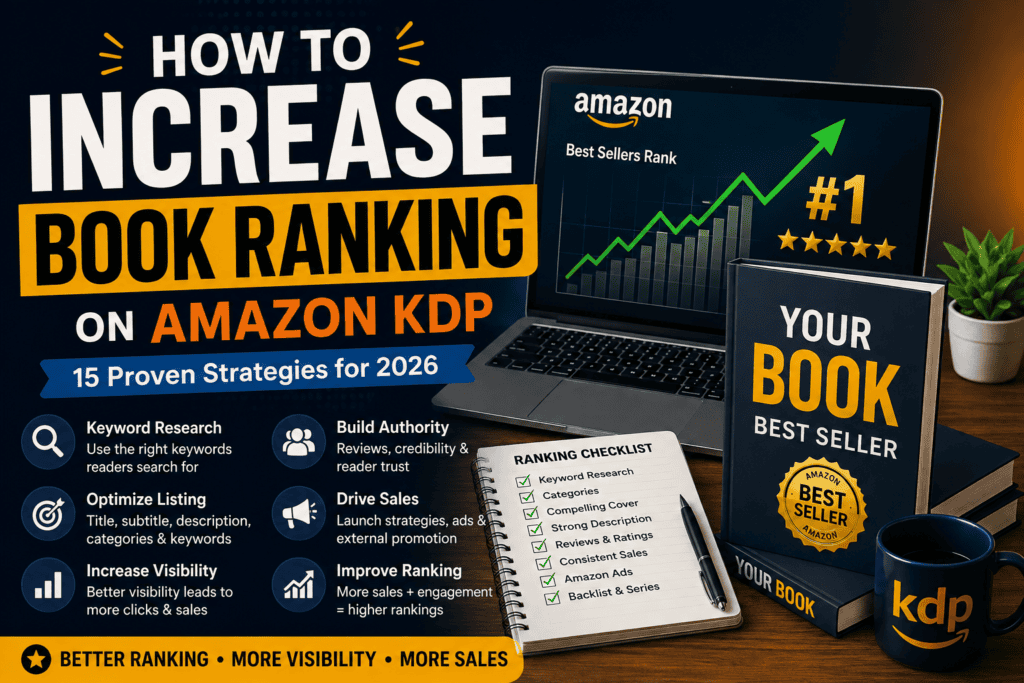
Table of Contents
1. Start With the Right Book Topic
Before worrying about rankings, make sure you’re publishing a book that has a clear audience.
A book can be perfectly optimized and still struggle if very few readers are interested in the topic.
Before publishing, research:
- Reader demand
- Competing books
- Search phrases
- Book categories
- Reader reviews
- Common problems or interests
- Opportunities to differentiate your book
Your objective isn’t to copy bestselling books.
Instead, identify what readers want and create a better or more clearly positioned product.
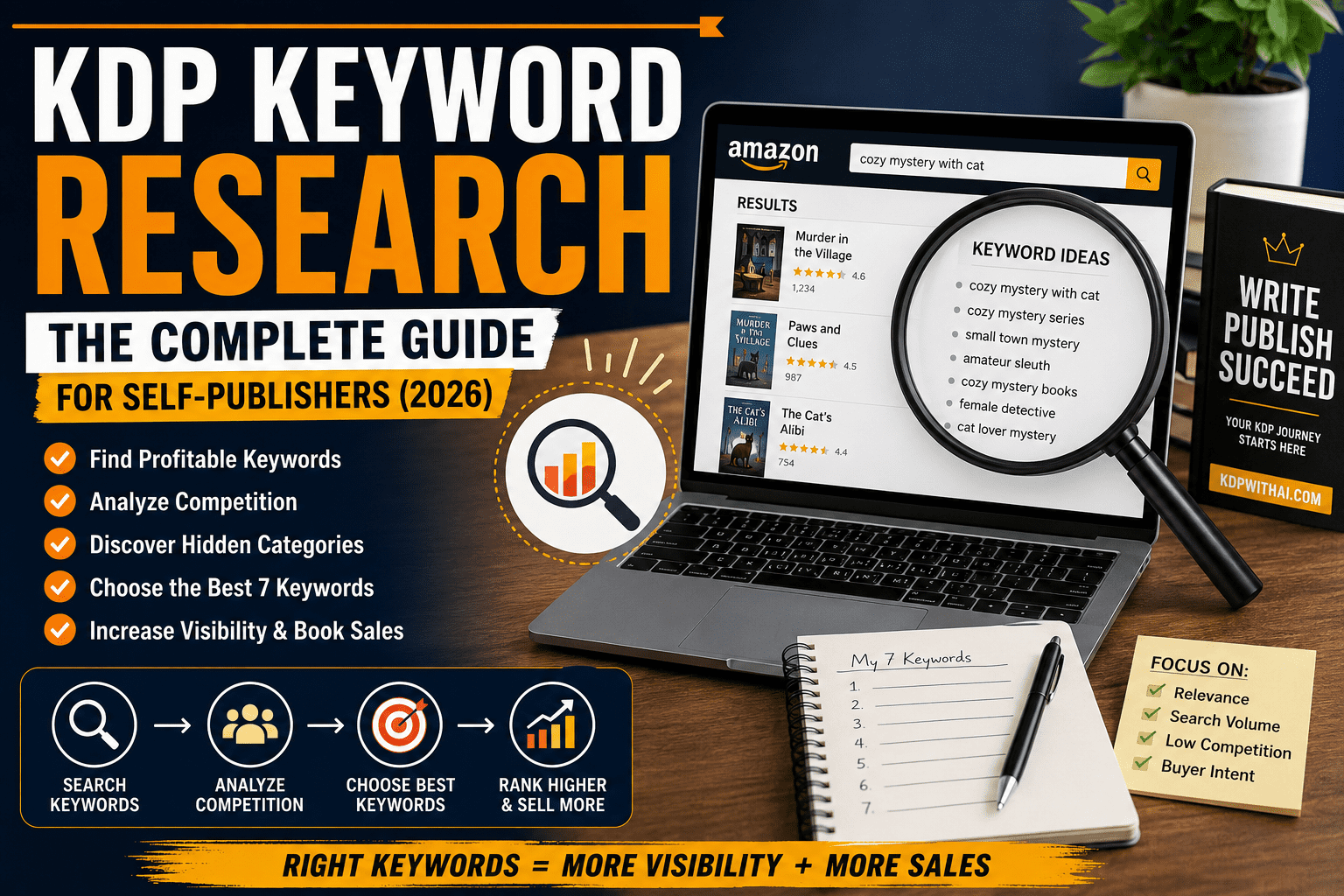
2. Conduct Amazon KDP Keyword Research
Keywords help Amazon understand what your book is about and help readers discover it through relevant searches.
Amazon currently allows authors to add up to seven keywords or short phrases at the title level. Amazon recommends using keywords that accurately relate to the book and avoiding vague terms.
For example, instead of a broad keyword such as:
business
a more specific phrase might be:
small business startup guide
Your keywords should reflect genuine reader search intent.
For a deeper process, read our Amazon KDP Keyword Research guide.
3. Choose Relevant Categories
Categories help position your book within Amazon’s bookstore.
Don’t select a category simply because it looks easy to rank in.
Instead, ask:
- Does this category accurately describe my book?
- Would my target reader browse this category?
- Are similar books appearing here?
- Does the category match my book’s actual content?
Amazon specifically recommends accurate book details and explains that categories and keywords can help readers find books.
You can learn more in our Amazon KDP Categories Explained guide.
4. Optimize Your Title and Subtitle
Your title and subtitle should immediately communicate what the book is about.
For nonfiction, a strong subtitle can clarify:
- Target audience
- Main problem
- Desired outcome
- Book format or approach
For example:
Weak:
Productivity
More descriptive:
Productivity for Entrepreneurs: A Practical System for Managing Time, Focus, and Priorities
Don’t stuff keywords unnaturally into the title.
Your metadata should accurately represent the actual book.
Struggling to Sell Your KDP Book? Your Title Might Be Killing It.
KDP Title Secrets: Rank Higher & Sell More Books
5. Create a Professional Book Cover
Your cover affects whether people click on your book after seeing it in search results or recommendation areas.
A good KDP cover should:
- Match the genre
- Be readable as a thumbnail
- Use appropriate typography
- Communicate the subject quickly
- Look professional beside competing books
Your cover doesn’t need to look identical to bestselling books.
It needs to communicate professionalism and reader expectations.
If you need help creating a professional cover, you can explore our Book Cover Design Services.
6. Improve Your Amazon Book Description
Once a reader clicks your book, your description needs to convince them to continue.
Amazon recommends making descriptions simple, compelling, and professional.
A strong nonfiction description can include:
The Problem
What does the reader struggle with?
The Promise
What will they learn?
The Benefits
What practical outcomes can they expect?
The Audience
Who is this book for?
The Contents
What important topics are covered?
Don’t turn the description into a giant block of keywords.
Write for humans first.
7. Build Genuine Sales Activity
Amazon’s Best Seller and Category Ranks are based on customer activity relative to other books.
That means genuine purchases matter.
Instead of trying to artificially manipulate rankings, focus on generating real demand through:
- Email marketing
- Social media
- Your website
- Reader communities
- Book launches
- Advertising
- Author networking
- Relevant content marketing
The objective is to bring real interested readers to your book.
8. Build an Author Platform
Don’t depend entirely on Amazon to find your readers.
Build assets you control:
- Author website
- Email list
- YouTube
- Relevant communities
Your website can become particularly valuable because every blog article can send readers toward your books.
For example:
↓
↓
↓
This creates a long-term traffic system.
9. Publish Multiple Related Books
One book gives you one product.
A catalog gives readers multiple opportunities to discover you.
Instead of publishing completely unrelated books, consider building:
- A nonfiction series
- A fiction series
- Companion books
- Workbooks
- Specialized guides
- Related books for the same audience
When appropriate, connect related books through series information and your back matter.
This is particularly useful because readers who discover one book can potentially discover your other titles.
10. Use Series Strategy
For fiction especially, a series can create a stronger reader journey.
For example:
Book 1 → Book 2 → Book 3 → Book 4
Your first book can introduce the world and characters, while later books give readers additional reasons to continue.
But don’t create a series merely because series books can sell.
The books must deliver what readers expect.
11. Improve Your Book’s Conversion Rate
Getting impressions is only half the job.
You also need readers to click and purchase.
Think about your Amazon listing as a funnel:
Impression
↓
Cover + Title
↓
Click
↓
Description
↓
Preview
↓
Purchase
If your book gets impressions but few clicks, investigate:
- Cover
- Title
- Subtitle
- Search intent
If people click but don’t buy, investigate:
- Description
- Preview
- Pricing
- Reviews
- Overall positioning
12. Encourage Genuine Reader Reviews
Reviews can provide valuable social proof.
The safest approach is to encourage readers to leave honest feedback without trying to control what they say.
Avoid:
- Buying reviews
- Fake reviews
- Manipulating ratings
- Offering incentives for positive reviews
- Asking people to misrepresent their experience
Build reviews through real readers and a quality product.
13. Test Amazon Advertising
Amazon Ads can help authors place their books in front of relevant readers.
Start with a controlled budget and monitor performance.
Track:
- Impressions
- Clicks
- Click-through rate
- Cost per click
- Orders
- Advertising spend
- Conversion
Don’t assume that increasing the advertising budget automatically improves organic ranking.
Advertising should be treated as a marketing experiment.
14. Monitor Your Data
One of the biggest mistakes authors make is publishing a book and never looking at the data.
Monitor:
- Sales
- Orders
- KENP reads if applicable
- Advertising performance
- Search visibility
- Customer feedback
- Book rankings
- Website traffic
Amazon’s KDP Dashboard provides information such as orders, estimated royalties, and KENP reads, allowing authors to monitor performance over time.
Your data should influence your next decision.
15. Keep Improving Your Book
Publishing isn’t the end of the process.
If your book isn’t performing as expected, investigate the problem.
Low impressions?
Look at:
- Keywords
- Categories
- Metadata
- Topic demand
High impressions but low clicks?
Look at:
- Cover
- Title
- Subtitle
Clicks but few purchases?
Look at:
- Description
- Preview
- Pricing
- Reviews
- Product positioning
Make changes carefully and give Amazon time to process updates. Amazon says updates to keywords, descriptions and categories can take time to appear, and sales-rank updates can also take time after sales or category changes.
What NOT to Do
Trying to increase rankings through shortcuts can create more problems than benefits.
Avoid:
❌ Fake sales
❌ Fake reviews
❌ Misleading keywords
❌ Irrelevant categories
❌ Keyword stuffing
❌ Misleading metadata
❌ Copying competing books
❌ Promising guaranteed rankings
Instead, focus on:
Relevance + Quality + Discoverability + Real Readers + Consistent Marketing
A Simple Amazon KDP Ranking Strategy
Use this framework:
STEP 1 — RESEARCH
Find a real reader demand.
↓
STEP 2 — CREATE
Write a genuinely useful or entertaining book.
↓
STEP 3 — PACKAGE
Create a professional cover and formatting.
↓
STEP 4 — OPTIMIZE
Improve keywords, categories, metadata, and description.
↓
STEP 5 — LAUNCH
Generate legitimate reader awareness.
↓
STEP 6 — MARKET
Use content, email, social media, and advertising.
↓
STEP 7 — ANALYZE
Study results.
↓
STEP 8 — IMPROVE
Make informed changes.
↓
STEP 9 — REPEAT
Build your publishing catalog.
Need Professional KDP Publishing Help?
Publishing a book involves much more than uploading a manuscript.
If you need help with:
- Book writing
- Ghostwriting
- Editing
- Proofreading
- Cover design
- Kindle formatting
- Paperback formatting
- Keyword research
- Category research
- Amazon KDP SEO
- KDP setup
- Book upload and publishing
our complete KDP publishing service can handle the publishing workflow for you.
📚 Ready to Publish Your Book?
Chat with KDP With AI on WhatsApp
Final Thoughts
There is no guaranteed formula for reaching the top of Amazon search results. Amazon itself says search results can change and that neither Amazon nor KDP guarantees a particular search position.
The better strategy is to build a book that readers actually want, make it easy for Amazon to understand through accurate metadata, create a compelling product page, generate genuine customer activity, and continuously improve your publishing and marketing system.
If you consistently apply these principles across multiple books, you’re not simply trying to increase one book’s ranking—you are building a long-term Amazon KDP publishing business.