
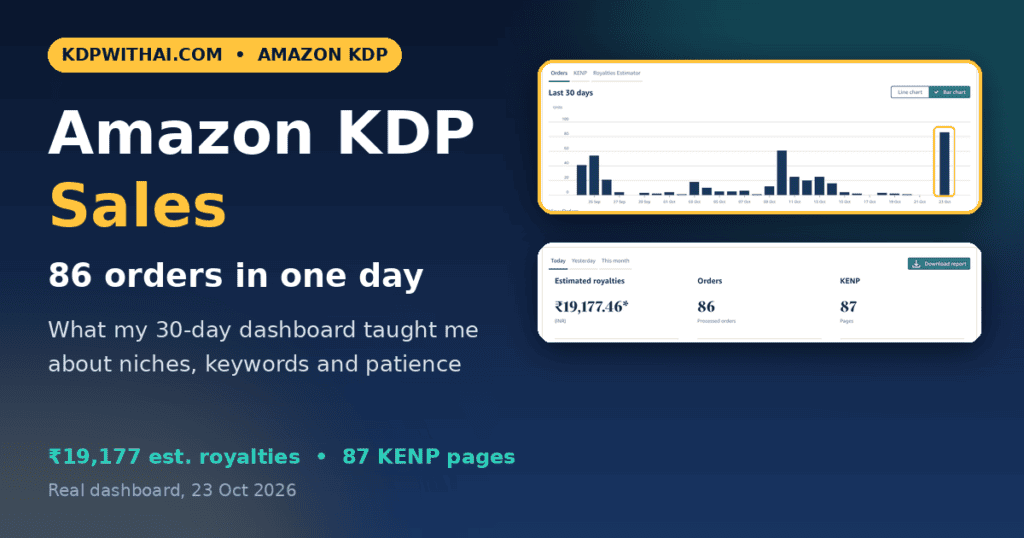
Amazon KDP sales can look dead one week and explode the next. Two weeks ago, my dashboard looked almost flat. Several days showed zero orders. A few showed two or three. If you had asked me then whether the whole project was working, I would have said “not really.”
Then came 23 October 2026, and the dashboard showed 86 processed orders, 87 KENP pages read and about ₹19,177 in estimated royalties in a single day.
I am not sharing this to brag. I am sharing it because a chart like this teaches more than any single number does. Most beginners either quit during the quiet weeks, or they treat one big day as proof that they have “cracked” KDP. Both reactions are mistakes.
In this article, I will walk through what my 30-day chart actually shows, what I believe moves KDP sales, what I am still unsure about, and the simple system I follow so I am not relying on luck.
1. What my 30-day chart really shows about Amazon KDP sales
Look at the bar chart in the screenshot above. It tells a story with four parts:
- Late September: a burst of orders, with one day above 50.
- Early October: a long, quiet stretch. Most days are well below 20 orders, and some are close to zero.
- Around 10 October: a bump of roughly 60 orders, followed by a few decent days.
- 23 October: the biggest bar on the chart, at 86 orders.
Notice what is missing: a smooth upward line. KDP rarely works that way. If you only looked at the chart on 20 October, you would have seen a dying business. If you only looked on 23 October, you would have seen a booming one. Neither view is the full picture.
2. Why Amazon KDP sales are lumpy
Amazon KDP sales do not arrive on a schedule. They come when several things line up at the same time, for example:
- a search keyword that suddenly gets more traffic,
- a seasonal trend or event,
- a ranking improvement that puts your book in front of more buyers,
- a promotion, a price change or a ripple from another book in the same niche.
You cannot control the exact day this happens. What you can control is how many well-positioned books you have ready to catch it. One book that is invisible catches nothing. Several books with good titles and keywords in niches people actually search for give you many more chances.
This is also why I check my dashboard once a week, not every day. Daily checking turns normal variation into stress and leads to bad decisions, such as changing a title the day after a slow day.
3. Niche research comes first
The biggest difference between books that sell and books that do not is usually decided before a single page is created. If nobody is searching for what you are publishing, even a beautifully designed book stays at zero.
If you are still stuck at this step, my step-by-step guide on how to choose a profitable KDP niche covers the whole process.
What I look for in a niche
- Proof of demand: competing books in the niche are actually selling. I look at their sales ranks, not just their review counts.
- Room for a better book: existing books have weak covers, thin content or poor titles that you can realistically improve on.
- Multiple search angles: the topic can be described in several different phrases, which gives you more keyword options.
- A clear buyer: you can say in one sentence who the book is for and what problem it solves or what use it has.
4. Titles, subtitles and keywords
Amazon is a search engine before it is a bookstore. Buyers type phrases into the search bar, and Amazon shows books whose titles, subtitles and keywords match those phrases and have a history of selling.
That means your metadata does a lot of the selling work. Here is how I approach it:
- Start with real search phrases. I look at what the Amazon search bar suggests as I type, and at the wording top-selling competitors use.
- Put the main phrase in the title naturally. A title should be clear first and clever second.
- Use the subtitle to add context and extra keywords. It should explain who the book is for and what they get.
- Fill the backend keyword slots. KDP gives you seven keyword boxes. Use them for phrases not already in your title, and avoid repeating the same words.
- Pick categories that match the buyer’s intent, not just the broadest possible category.
Many of my slower books were quiet simply because their titles and keywords did not match how people search. The content was not the problem. When I rewrote metadata around real search language, several books started to move. For a deeper walkthrough, see my guides on KDP keyword research and Amazon KDP SEO.
5. Quality and usefulness
Metadata can get a buyer to click, but the book itself decides whether they keep it, review it well, or return it. A thin, copy-pasted or confusing book may sell a few copies and then collect poor reviews or returns, which hurts you over time.
Whether you create journals, planners, activity books, workbooks or guides, ask yourself three questions before you publish:
- Would I be happy to buy this if I were the customer?
- Is the layout clean, consistent and easy to use?
- Is it clearly different from, or better than, the top books in the niche?
AI tools can speed up ideation, outlining, drafting and layout work. They do not remove the need for your judgment, editing and quality control. Treat AI as an assistant, not as a replacement for checking your own work. Also remember to follow Amazon’s current content and AI-disclosure guidelines when you publish.
6. Patience and how to track results
Some books sit near zero for weeks, then start selling once Amazon has enough data on how buyers respond. If you judge a book after three days, you may kill something that was about to work.
If you are still working toward your first 100 book sales, this patience matters even more. My tracking habits are simple:
- Check the dashboard weekly, and review the 30-day chart monthly.
- Note which books and which metadata changes were made before an improvement.
- Give a new book several weeks before changing its title or keywords, unless there is an obvious mistake.
- When something shows traction, build more in that niche rather than starting from scratch every time.
7. A repeatable KDP system
Luck is not a strategy. Here is the loop I follow, and the one I recommend to beginners:
- Research a niche with proven demand and beatable competition.
- Plan the book: who it is for, what it includes and how it will be better than what exists.
- Create a clean, useful book with consistent formatting and a professional cover.
- Optimize the title, subtitle, keywords, categories and description around real search phrases.
- Publish and leave it alone for a few weeks while data builds.
- Review the numbers weekly, then double down on what shows traction and quietly drop what does not.
Want the full step-by-step process?
I put the entire journey from picking a niche to publishing and optimizing into one beginner-friendly guide.
Get “From Idea to Income” on Gumroad →8. Common beginner mistakes
- Copying a bestseller exactly. If your book adds nothing new, there is no reason for Amazon or buyers to prefer it.
- Publishing in bulk with no research. Volume without demand just creates many invisible books.
- Ignoring keywords. Great content with a weak title is a hidden book.
- Quitting during the quiet weeks. As the chart shows, quiet stretches are normal.
- Over-reacting to one big day. A spike is a signal to investigate, not a reason to quit your job.
- Changing too many things at once. If you change the title, cover, price and keywords together, you will never know what worked.
9. What I am still unsure about
Honesty matters more than hype, so here is what I do not know yet:
- Whether the 23 October spike was seasonal, a one-off or the start of a new baseline.
- Exactly which books drove most of the 86 orders. I am still going through the Orders report to find out.
- Whether the sales rate will hold over the coming weeks.
If you also run a KDP account, I recommend doing the same exercise: open the Orders report, break sales down by book and by marketplace, and write down what you notice. That analysis is far more valuable than the headline number.
10. Frequently asked questions
Is Amazon KDP still worth it in 2026?
Yes, but low-effort and saturated books are much harder to sell. Books built on real niche research, with strong titles and keywords, can still sell. Results vary and nothing is guaranteed. For a full breakdown of earnings, costs and pros and cons, read Is KDP still worth it in 2026?
Why do my KDP sales go up and down so much?
KDP sales are lumpy. Rankings, seasonal search trends, keyword changes and promotions can line up on one day and cause a spike, followed by quiet days. Judge performance weekly or monthly, not daily.
How long does it take for a KDP book to start selling?
It varies. Some books sell within days, while others sit near zero for weeks before Amazon has enough data to rank them. Plan to wait several weeks before judging a book.
Are KDP royalty numbers in the dashboard final?
No. The dashboard shows estimated royalties. KENP numbers can change and are finalized around the 15th of the following month.
Do I need to publish many books to succeed on KDP?
Not necessarily. A few well-researched books in niches with proven demand usually beat dozens of books published without research.
Final thoughts
One day with 86 orders does not make a business, and one quiet week does not break one. What the chart really shows is that Amazon KDP sales reward people who research before they create, optimize before they publish, and stay patient while the data builds.
If you are just starting out, focus on the system: pick niches with real demand, write titles around real searches, publish useful books and review your numbers weekly. The spikes tend to follow.
Ready to build your own KDP system?
Get the complete beginner guide covering niche research, publishing and optimization.
Download the guide →Disclaimer: The figures in this article come from my own KDP dashboard on 23 October 2026 and are estimates that may change. Results vary by niche, book quality, marketing and market conditions, and no income is guaranteed. KDP policies and features change, so always check Amazon’s current KDP help pages.