
Finding the right keywords is one of the most important parts of making a book discoverable on Amazon.
If readers search for a topic, genre, character type, problem, or theme that matches your book, relevant keywords can help Amazon understand what your book is about and connect it with appropriate searches.
That’s why many authors look for a free Amazon KDP keyword tool before publishing.
But keyword research doesn’t have to mean finding a magical keyword with thousands of searches. Good KDP keyword research is about understanding what your readers are actually looking for and choosing accurate phrases that describe your book.
Amazon itself recommends thinking like a reader when selecting keywords and allows authors to use up to seven keywords or short phrases at the title level.
In this guide, you’ll learn how to conduct Amazon KDP keyword research for free, how to evaluate keyword ideas, what mistakes to avoid, and how to turn your research into a practical KDP metadata strategy.
How to Publish on Amazon KDP–guide
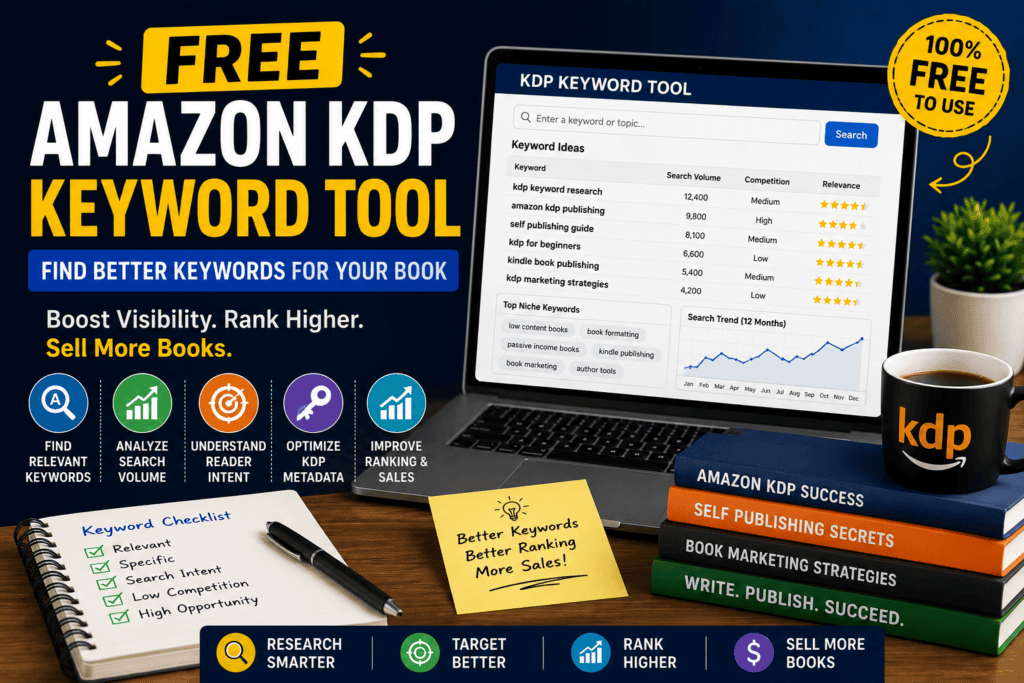
Table of Contents
What Is an Amazon KDP Keyword?
An Amazon KDP keyword is a word or phrase that helps describe the content, topic, genre, theme, setting, or reader intent associated with your book.
For example, imagine you’re publishing a nonfiction book about starting a small business.
Possible keyword ideas might include:
- small business startup
- entrepreneurship guide
- starting a business
- business planning
- entrepreneur basics
For fiction, the approach can be different.
A fantasy romance author might research concepts such as:
- enemies to lovers fantasy
- fae romance
- dark fantasy romance
- magical kingdom
- forbidden love
The important point is relevance.
A keyword should describe something genuinely present in your book.
Amazon’s current metadata guidelines specifically prohibit misleading or unrelated keywords.
Why KDP Keyword Research Matters
Your title, subtitle, description, categories, and keywords collectively communicate information about your book.
Amazon says relevant keywords can help make books easier to find, alongside factors such as sales history and Best Sellers Rank.
Good keyword research can help you:
- Understand reader intent
- Discover specific topics readers search for
- Improve book metadata
- Find long-tail keyword opportunities
- Identify content themes
- Build better titles and subtitles
- Plan future books
- Improve your overall KDP SEO strategy
However, keywords do not guarantee rankings or sales.
They are one part of a larger publishing and marketing system.
How to Find KDP Keywords for Free
You don’t necessarily need an expensive keyword research subscription to start.
Here is a simple free workflow.
Step 1: Start With Your Book Topic
Write down the main subject of your book.
For example:
Book topic:
Now brainstorm related concepts:
- KDP publishing
- self publishing
- Amazon publishing
- Kindle publishing
- publishing a book
- KDP beginner guide
Don’t worry about choosing your final keywords yet.
First create a large idea list.
Step 2: Think Like Your Reader
Ask:
“If I wanted this book, what would I type into Amazon?”
This is one of Amazon’s own recommended approaches to keyword research.
For example, someone interested in a book about productivity might search:
productivity for entrepreneurs
rather than simply:
productivity
The more specific phrase may communicate stronger reader intent.
Step 3: Use Amazon Search Suggestions
This is one of the most useful free methods.
Go to Amazon and begin typing your topic into the search bar.
For example:
Look at the suggestions Amazon provides.
These suggestions can give you ideas for phrases people may be searching for.
Repeat this process with different starting words.
For example:
Create a spreadsheet containing your ideas.
Step 4: Analyze Competing Books
Search Amazon for your main topic.
Look at approximately 10–20 relevant books.
Study:
- Titles
- Subtitles
- Categories
- Book descriptions
- Series names
- Reader reviews
- Recurring terminology
Don’t copy competitors.
Instead, identify patterns in the language readers and publishers use.
Step 5: Mine Reader Reviews
This is an underrated keyword research technique.
Read positive and negative reviews of competing books.
Look for phrases readers naturally use.
For example:
“I needed a beginner-friendly guide to publishing.”
That could reveal a reader-intent concept such as:
beginner KDP guide
Another reader might say:
“I wanted to understand Amazon keywords.”
That gives you another possible topic phrase.
Reviews can therefore help you understand problems, expectations, and vocabulary.
Step 6: Create a Keyword Spreadsheet
Create columns like this:
| Keyword | Relevance | Search Intent | Competition | Use? |
|---|---|---|---|---|
| KDP publishing | High | Informational | High | Maybe |
| KDP beginner guide | High | Informational | Medium | Yes |
| Amazon KDP keywords | High | Informational | Medium | Yes |
| self publishing | Medium | Broad | High | Maybe |
| KDP metadata | High | Informational | Medium | Yes |
You don’t need perfect search-volume data to begin.
Your first job is to identify relevant opportunities.
Step 7: Focus on Specific Phrases
Broad keywords can be difficult to interpret.
Compare:
Broad:
publishing
More specific:
Amazon KDP publishing
Even more specific:
Amazon KDP publishing for beginners
Specific phrases can communicate stronger intent.
Amazon recommends using phrases that accurately describe your book and notes that keywords are often best used as relevant phrases rather than vague terms.
Step 8: Use Up to Seven KDP Keywords Strategically
Amazon currently allows authors to select up to seven keywords or short phrases for a book.
Don’t treat this as a requirement to stuff seven unrelated phrases into your metadata.
Instead, select the strongest relevant concepts that aren’t already adequately represented elsewhere in your metadata.
For example:
- KDP publishing for beginners
- self publishing guide
- Amazon book publishing
- first time author
- publishing a book online
- Kindle publishing tips
- independent publishing
The exact keywords will depend on the actual content of the book.
What Keywords Should You Avoid?
This is extremely important.
Amazon’s current guidance says to avoid keywords that are misleading, unrelated, subjective, or promotional. It also specifically identifies several types of keywords to avoid, including other authors’ names, sales-rank claims, promotional terms, unrelated content, and Amazon program names such as Kindle Unlimited or KDP Select.
Avoid things such as:
❌ bestselling author
❌ #1 bestseller
❌ another author’s name
❌ unrelated popular topics
❌ free when it doesn’t accurately describe the book
❌ misleading categories
❌ competitor trademarks you aren’t authorized to use
❌ keyword stuffing
The goal is accurate discoverability, not manipulation.
Don’t Put Everything Into Your Keywords
One common mistake is trying to repeat every possible phrase everywhere.
Your book metadata works as a system.
Amazon’s current guidance says keywords can capture useful information that isn’t already represented in the title and description, and recommends avoiding information already covered elsewhere in metadata or categories.
So instead of repeating:
Amazon KDP
Amazon KDP
Amazon KDP
use your keyword fields to communicate additional relevant concepts.
Free KDP Keyword Research Workflow
Here’s the complete process:
BOOK TOPIC
↓
READER
Who is the book for?
↓
AMAZON SEARCH
Look at search suggestions.
↓
COMPETING BOOKS
Study similar titles.
↓
READER REVIEWS
Identify real reader language.
↓
KEYWORD LIST
Create 20–50 relevant ideas.
↓
FILTER
Remove irrelevant or misleading terms.
↓
PRIORITIZE
Select the strongest concepts.
↓
KDP METADATA
Use appropriate keywords in the relevant fields.
↓
MONITOR
Review performance and update when appropriate.
Free Amazon KDP Keyword Research Checklist
Before publishing your book, ask:
☐ Does this keyword accurately describe my book?
☐ Would my target reader actually search for it?
☐ Is the phrase specific enough?
☐ Is it already adequately represented elsewhere in my metadata?
☐ Is it relevant to my actual content?
☐ Am I avoiding misleading claims?
☐ Am I avoiding competitor names?
☐ Am I avoiding promotional language?
☐ Have I checked Amazon’s current keyword guidance?
KDP Keywords vs Google SEO Keywords
These are related but not identical.
Google SEO
Primarily focuses on helping web pages appear in Google search.
Amazon KDP Keywords
Help Amazon understand the book and connect it with relevant searches within the Amazon Store.
Therefore, don’t simply take a list of Google keywords and paste it into your KDP dashboard.
Research Amazon reader intent specifically.
What If a Keyword Has Low Competition?
Low competition can be attractive, but don’t choose a keyword simply because few books appear for it.
Ask:
Is there actually a meaningful audience behind this search?
A highly relevant keyword with moderate competition can be more valuable than an extremely obscure keyword nobody uses.
Relevance comes first.
Can You Change KDP Keywords Later?
Yes. Amazon currently allows authors to update keywords at the title level through KDP.
Amazon’s guidance also says keywords can be changed and descriptions can be updated after publication, subject to the applicable metadata rules and update process.
That means keyword research shouldn’t be treated as a one-time activity.
If your book isn’t getting the visibility you expected, review the complete listing rather than immediately assuming the keywords are the only problem.
The Bigger KDP SEO Picture
Keywords are only one part of Amazon discoverability.
Think of your publishing system as:
Topic
↓
Title & Subtitle
↓
Keywords
↓
Categories
↓
Description
↓
Cover
↓
Reader Experience
↓
Marketing
↓
Sales & Customer Activity
This is why keyword optimization works best when it is connected to your overall publishing strategy.
For more information, read our Amazon KDP SEO guide and Amazon KDP Categories Explained guide.
Need Professional KDP Keyword Research?
If you’re publishing a book but aren’t sure which keywords, categories, metadata, or positioning to use, our KDP publishing and SEO service can help with the complete publishing workflow.
We can assist with:
- KDP keyword research
- Category research
- Metadata optimization
- Book description
- Cover design
- eBook formatting
- Paperback formatting
- KDP setup
- Book upload
- Publishing support
📚 Want Help Publishing Your Book?
Final Thoughts
A free Amazon KDP keyword tool can be useful, but the tool itself isn’t the most important part of keyword research.
The real advantage comes from understanding your reader.
Start with the book topic, think like your target customer, study Amazon search suggestions, analyze competing books, read customer reviews, build a list of relevant phrases, and then select keywords that accurately represent your book.
Remember that keywords are only one component of a successful KDP strategy. A strong book, professional packaging, relevant metadata, reader satisfaction, and consistent marketing all work together.
If you want to improve your Amazon discoverability, start with relevance rather than keyword volume.