
Amazon KDP SEO: How to Rank Your Books Higher on Amazon in 2026
Amazon KDP SEO is the process of optimizing your book listing so it ranks higher in Amazon search results and reaches more readers. Whether you’re publishing your first book or managing a growing catalog, understanding Amazon SEO can significantly improve your visibility, clicks, and sales.
Many authors focus on writing a great book but overlook optimization. As a result, their books remain hidden despite being valuable to readers. In this guide, you’ll learn how Amazon KDP SEO works and how to optimize your books for better rankings in 2026.
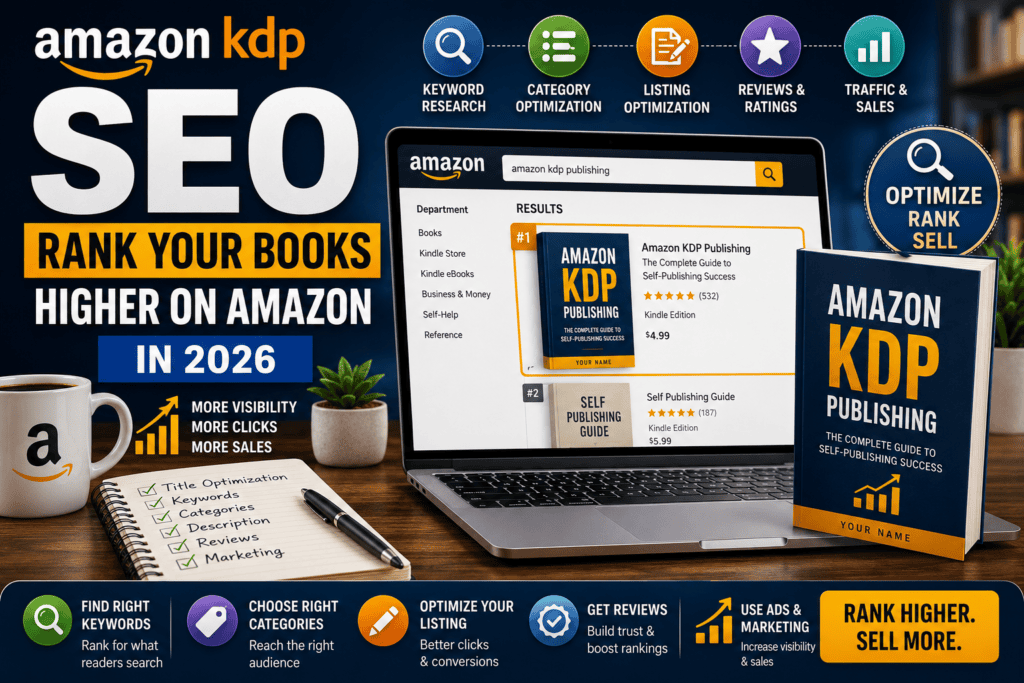
Table Of Contents
What Is Amazon KDP SEO?
Amazon KDP SEO refers to optimizing your book’s metadata, keywords, categories, title, description, and marketing signals so Amazon can better understand and recommend your book.
Just like Google uses SEO to rank websites, Amazon uses its own search algorithm to rank books.
Amazon evaluates factors such as:
- Keywords
- Categories
- Sales history
- Conversion rate
- Reviews
- Relevance
- Reader engagement
The better optimized your book is, the greater the chance it appears in relevant searches.
Why Amazon SEO Matters
Every day, millions of readers search for books on Amazon.
If your book appears near the top of search results, you gain:
- More visibility
- More clicks
- More sales
- Better rankings
- Increased organic traffic
Without proper optimization, even a great book can struggle to attract readers.
Amazon KDP SEO helps ensure your book gets discovered.
How Amazon Search Works
When a reader searches for something like:
amazon kdp publishingor
self publishing guideAmazon tries to show the most relevant books.
The algorithm considers:
Relevance
Does your book match the search term?
Performance
Does your book sell well for that keyword?
Conversion Rate
Do readers click and purchase the book?
Customer Satisfaction
Does the book receive positive reviews?
The goal is to present books most likely to satisfy buyers.
Step 1: Conduct Proper Keyword Research
Keyword research is the foundation of Amazon KDP SEO.
Your keywords help Amazon understand what your book is about.
Good Keyword Examples
Instead of:
businessUse:
small business startup guideInstead of:
marketingUse:
digital marketing for beginnersLong-tail keywords are often easier to rank for and attract targeted readers.
Places to Find Keywords
- Amazon Search Suggestions
- Competitor Analysis
- Reader Reviews
- Amazon Categories
- Publisher Rocket
- Google Trends
For a complete walkthrough, read our Amazon KDP Keyword Research guide.
Step 2: Optimize Your Book Title and Subtitle
Your title is one of the strongest ranking factors.
Weak Title
Publishing SuccessBetter Title
Amazon KDP Publishing Success: A Beginner's Guide to Self-Publishing and Book MarketingThe second title includes valuable keywords while remaining readable.
Tips
- Include primary keywords naturally
- Keep titles clear
- Avoid keyword stuffing
- Focus on reader intent
A strong title improves both rankings and click-through rates.
Step 3: Choose the Right Categories
Categories help Amazon understand where your book belongs.
Many authors choose categories randomly, which limits discoverability.
Example
Instead of selecting:
BusinessYou might choose:
Entrepreneurshipor
Small BusinessTargeted categories often perform better.
Learn more in our article:
Amazon KDP Categories Explained
Step 4: Write a High-Converting Book Description
Your description helps convert visitors into buyers.
A strong description should:
- Grab attention
- Explain benefits
- Highlight key takeaways
- Include a call-to-action
Structure
Hook
Capture reader interest immediately.
Problem
Explain what challenge the reader faces.
Solution
Show how your book helps.
Benefits
Highlight outcomes and transformation.
Call to Action
Encourage readers to buy.
A well-written description improves conversion rates, which can positively influence rankings.
Step 5: Optimize Backend Keywords
Amazon allows authors to add backend keywords during book setup.
These keywords are invisible to readers but visible to Amazon’s algorithm.
Best Practices
Use:
- Synonyms
- Related phrases
- Alternative search terms
Avoid:
- Repeating title words
- Competitor names
- Misleading keywords
- Irrelevant terms
Backend keywords provide additional context to Amazon.
Step 6: Improve Your Book Cover
Your cover affects click-through rate.
Even if your book ranks well, a poor cover can reduce clicks.
Strong Covers Typically Have:
- Clear typography
- Professional design
- Genre alignment
- Visual hierarchy
- Readability at thumbnail size
Readers often decide within seconds whether to click on a book.
Investing in professional cover design can dramatically improve performance.
Explore our Cover Design Services if you need help creating a market-ready cover.
Step 7: Get More Reviews
Reviews help build trust and improve conversion rates.
Books with more positive reviews generally perform better.
Ethical Ways to Get Reviews
- Build an ARC team
- Ask readers politely
- Use your email list
- Engage your audience
Never buy fake reviews.
Amazon actively monitors review manipulation and may penalize accounts that violate guidelines.
Step 8: Use Amazon Ads
Amazon Ads can help generate visibility for new books.
Benefits include:
- Immediate exposure
- Keyword testing
- Increased sales velocity
- Data collection
Advertising can also help identify which keywords convert best.
You can then optimize your listing around proven search terms.
Learn more about advertising opportunities through Amazon Advertising.
Step 9: Create an Author Platform
Amazon rewards books that receive external traffic.
Building an audience outside Amazon can help drive sales.
Platforms to Consider
- Website
- Blog
- Email Newsletter
- YouTube
External traffic often leads to improved rankings and increased visibility.
You should also create your author profile through Amazon Author Central.
Step 10: Maintain Consistent Publishing Activity
Authors with multiple books often perform better.
Benefits include:
- More discoverability
- More cross-selling opportunities
- Increased reader trust
- Better long-term revenue
Publishing consistently helps build momentum over time.
Many successful KDP authors treat publishing as a long-term business rather than a one-time project.
Common Amazon KDP SEO Mistakes
Keyword Stuffing
Adding excessive keywords can make titles look unnatural.
Choosing Broad Keywords
Competing for extremely broad terms can be difficult.
Ignoring Categories
Categories are essential for discoverability.
Poor Cover Design
Low-quality covers reduce click-through rates.
Weak Descriptions
A weak description lowers conversions.
No Marketing Strategy
Publishing alone is not enough.
Books need visibility to generate sales.
Amazon KDP SEO Checklist
Before publishing, ensure you have:
✅ Keyword research completed
✅ Optimized title and subtitle
✅ Relevant categories selected
✅ Professional book cover
✅ Compelling book description
✅ Backend keywords optimized
✅ Author Central profile created
✅ Review strategy in place
✅ Marketing plan prepared
✅ Internal and external traffic sources established
How Amazon KDP SEO and Book Marketing Work Together
SEO helps readers find your book.
Marketing helps drive traffic to it.
The most successful authors combine:
- Keyword optimization
- Category research
- Professional design
- Reviews
- Advertising
- Content marketing
Together, these create a sustainable publishing strategy.
If you need help improving your rankings and visibility, explore our Amazon KDP SEO Services and Book Marketing Services.
Final Thoughts
Amazon KDP SEO is one of the most valuable skills a self-published author can learn. Optimizing your keywords, categories, metadata, descriptions, and marketing strategy can dramatically improve your book’s visibility and sales potential.
Success on Amazon rarely happens by accident. The authors who consistently rank and sell books understand how Amazon’s search algorithm works and optimize accordingly.
Start implementing these Amazon KDP SEO strategies today, and you’ll be in a much stronger position to attract readers, increase rankings, and build a profitable self-publishing business in 2026 and beyond.
Pingback: How to Get Your First 100 Book Sales on Amazon KDP (Proven Strategy for 2026)
Pingback: How to Build a Successful Amazon KDP Publishing Business in 2026