
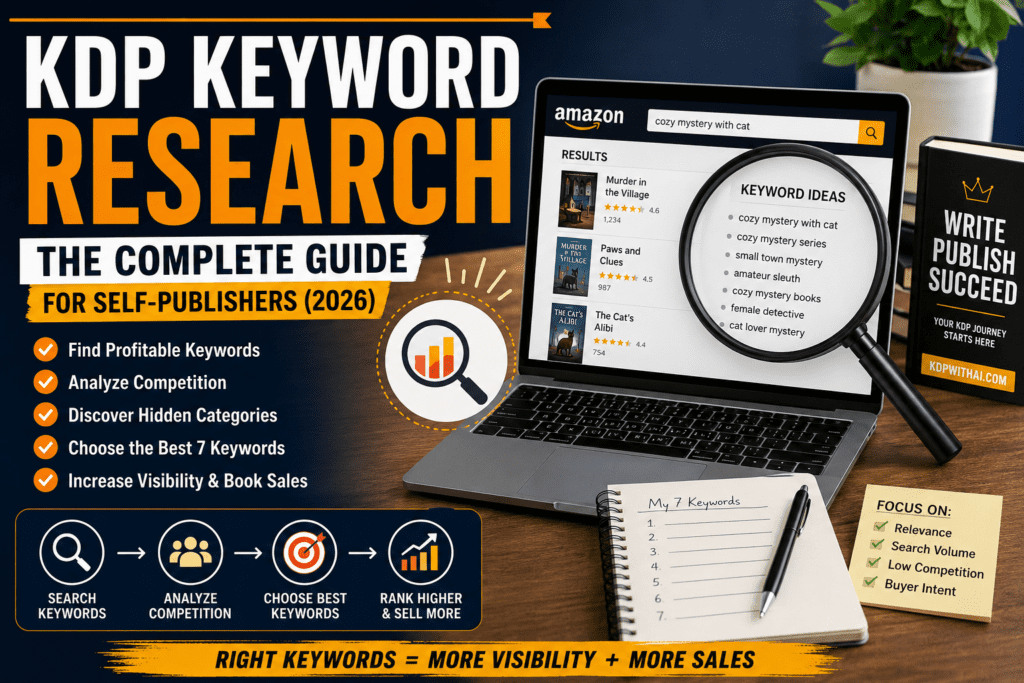
KDP Keyword Research: The Complete Guide for Self-Publishers (2026)
If readers can’t find your book on Amazon, they can’t buy it.
That’s why KDP keyword research is one of the most important skills every self-published author should learn. Whether you’re publishing fiction, nonfiction, journals, activity books, or low-content books, choosing the right keywords can significantly improve your book’s visibility in Amazon search results.
In this complete guide, you’ll learn how to do KDP keyword research, discover profitable long-tail keywords, analyze competitors, choose the best keyword phrases for your book, and avoid common mistakes that prevent books from getting discovered.
By the end of this guide, you’ll have a repeatable keyword research process you can use for every book you publish.
Want to publish your first book? Read our complete guide on How to Publish on Amazon KDP.
Step 3: Analyze Your Competitors
One of the biggest mistakes new KDP authors make is choosing keywords without checking the competition. Just because a keyword has high search volume doesn’t mean it’s the right choice.
The goal is to find keywords that have good demand but manageable competition.
Before you decide on your final keywords, spend some time studying the books that are already ranking on Amazon.
How to Analyze Competitors on Amazon
Follow these simple steps:
- Open Amazon and search your target keyword.
- Click on the first 10 books in the search results.
- Study each listing carefully.
- Make notes about what successful books have in common.
Look at:
- Book title
- Subtitle
- Cover design
- Book description
- Number of reviews
- Best Seller Rank (BSR)
- Categories
- Publication date
These details will help you understand what readers expect from books in your niche.
Signs of Low Competition
Low-competition keywords usually have:
- Books with fewer than 50–100 reviews
- Best Seller Rank above 100,000
- Older books with outdated covers
- Weak or poorly optimized descriptions
- Limited number of high-quality competitors
These keywords often provide better opportunities for new publishers.
Signs of High Competition
High-competition keywords usually have:
- Hundreds or thousands of reviews
- Best Seller Rank below 10,000
- Books from well-known publishers
- Professional cover designs
- Multiple bestselling authors dominating the niche
Ranking for these keywords is much harder, especially if you’re publishing your first book.
Competitor Analysis Checklist
Create a spreadsheet with these columns:
| Book | Reviews | BSR | Cover Quality | Categories | Notes |
|---|---|---|---|---|---|
| Book 1 | |||||
| Book 2 | |||||
| Book 3 |
Studying 10–20 competing books will reveal patterns that can guide your own keyword strategy.
Step 4: Use Publisher Rocket for Advanced Keyword Research
If you’re serious about publishing on Amazon KDP, Publisher Rocket is one of the most useful research tools available.
Instead of guessing which keywords might work, Publisher Rocket provides data that can help you make more informed decisions.
What Publisher Rocket Can Help You Find
- Keyword ideas
- Estimated Amazon search volume
- Competition level
- Estimated monthly earnings
- Relevant Amazon categories
- Competing books
This information helps you evaluate whether a keyword is worth targeting.
How to Use Publisher Rocket
Step 1
Enter your seed keyword.
Example:
cozy mysteryStep 2
Review the suggested keyword ideas.
Look for longer, more specific phrases that closely match your book.
Step 3
Compare keyword opportunities.
Instead of selecting the keyword with the highest search volume, look for a balance between demand and competition.
Step 4
Save your favorite keywords.
Create a shortlist of 15–20 promising keyword phrases before choosing your final seven.
Why Publisher Rocket Is Popular
Many experienced KDP publishers use Publisher Rocket because it combines keyword research, competitor analysis, and category research in one tool.
It can save hours of manual research, especially if you’re publishing multiple books each year.
Step 5: Discover Hidden Amazon Categories
Many authors don’t realize that keyword research can also help uncover category opportunities.
Choosing relevant categories increases the chances of reaching readers who are interested in your topic.
How to Find Categories
Method 1
Search your target keyword on Amazon.
Method 2
Open one of the top-ranking books.
Method 3
Scroll to the Product Details section.
You’ll often find the categories where the book is listed.
Method 4
Write down categories that repeatedly appear across several successful books.
These categories are often good starting points for your own research.
Why Categories Matter
Relevant categories can:
- Improve discoverability
- Help readers find your book
- Increase the chances of earning category bestseller badges
Avoid choosing categories that don’t accurately describe your book just because they appear less competitive.
Step 6: Choose Your Seven KDP Keywords
Amazon allows you to enter seven keyword fields when publishing your book.
Each keyword field can contain a phrase, giving you multiple opportunities to describe your book.
Rather than repeating the same words, use each field strategically.
Best Practices
✔ Use descriptive phrases instead of single words.
✔ Include reader intent.
✔ Mention themes, settings, or audience where appropriate.
✔ Avoid unnecessary repetition.
✔ Think about how a reader would naturally search for your book.
Example for a Productivity Book
Instead of:
productivityTry phrases like:
- productivity for entrepreneurs
- time management for busy professionals
- focus techniques for remote workers
- daily productivity habits
- morning routine for success
- work from home productivity
- goal setting strategies
Example for a Cozy Mystery
- cozy mystery with amateur sleuth
- small town mystery series
- culinary cozy mystery
- bakery mystery novel
- funny cozy mystery
- cat lover mystery
- clean mystery book
Fiction vs. Nonfiction Keyword Strategy
Different genres require different keyword approaches.
Fiction
Readers often search using:
- Genre
- Character type
- Setting
- Theme
- Tone
Examples:
- vampire romance
- enemies to lovers fantasy
- detective thriller
- clean romance
- small town mystery
Nonfiction
Readers usually search for:
- Problems
- Solutions
- Skills
- Outcomes
Examples:
- budget planning
- productivity habits
- intermittent fasting guide
- learn Python
- public speaking
Understanding how readers search can help you choose more relevant keywords.
AI Tools That Can Help With Keyword Research
Several AI tools can assist with brainstorming and organizing keyword ideas.
They can help you:
- Generate long-tail keyword ideas
- Group related keywords
- Identify reader questions
- Organize research into lists
Useful tools include:
Remember that AI suggestions should be validated using Amazon search results and other research methods before you use them.
Common KDP Keyword Mistakes to Avoid
Even experienced self-publishers sometimes make keyword mistakes that reduce their book’s visibility on Amazon. Avoiding these errors can significantly improve your chances of ranking higher in Amazon search results.
1. Using Single Generic Keywords
Generic keywords like:
- Mystery
- Romance
- Cookbook
- Finance
are extremely competitive.
Instead, use descriptive long-tail phrases.
Instead of:
MysteryUse:
Small town cozy mystery with amateur sleuth2. Repeating the Same Word
Many beginners waste keyword slots like this:
- mystery novel
- mystery books
- mystery thriller
- mystery detective
Amazon already understands similar words.
Instead, use different search phrases that cover various reader intents.
3. Using Competitor Author Names
Never use another author’s name as a keyword.
Examples:
❌ Stephen King
❌ Colleen Hoover
❌ James Patterson
This violates Amazon’s metadata guidelines and may result in your metadata being rejected or changed.
4. Using Your Book Title
Amazon already indexes your title and subtitle.
There’s usually no benefit to repeating them in your keyword fields.
5. Ignoring Reader Intent
Don’t think like an author.
Think like a customer.
Ask yourself:
What would someone actually type into Amazon to find this book?
That’s the keyword you want.
6. Never Updating Keywords
Keyword research isn’t a one-time task.
Review your keywords every 60–90 days.
Update them if:
- Sales decline
- Search trends change
- Competition increases
- Better keyword opportunities appear
Free KDP Keyword Research Tools
You don’t need expensive software to get started.
These free tools can help you discover valuable keyword ideas.
Amazon Search Autocomplete
The best free keyword tool available.
Simply begin typing your topic into Amazon and record the suggestions.
Google Trends
Useful for identifying seasonal interest and comparing topics over time.
Great for nonfiction books and trending subjects.
Google Keyword Planner
Although designed for advertisers, it can still provide useful keyword ideas for certain niches.
AnswerThePublic
Excellent for discovering reader questions and informational topics.
Useful when writing nonfiction books.
Google Search Suggestions
Typing your topic into Google can also generate useful long-tail ideas that may translate well to Amazon searches.
KDP Keyword Research Checklist
Before publishing your book, make sure you’ve completed the following:
✅ Brainstormed 15–20 seed keywords
✅ Used Amazon autocomplete
✅ Analyzed the top 10 competing books
✅ Reviewed categories
✅ Selected seven unique keyword phrases
✅ Avoided keyword repetition
✅ Focused on reader search intent
✅ Saved your keyword research for future updates
Example Keyword Strategy
Book Topic
Amazon KDP Publishing
Possible keyword phrases:
- Amazon KDP for beginners
- how to publish on Amazon KDP
- Kindle Direct Publishing guide
- self publishing on Amazon
- KDP publishing guide
- publish your first Kindle book
- Amazon self publishing guide
These keywords target different search intents while remaining highly relevant.
Frequently Asked Questions
How many keywords can I use in Amazon KDP?
Amazon allows you to enter seven keyword fields when publishing your book. Each field should contain a unique keyword phrase rather than repeating the same terms.
Can I change my KDP keywords after publishing?
Yes.
You can update your keywords anytime from your KDP Bookshelf.
Changes are usually reflected within 24–72 hours, although indexing times may vary.
Should I use keywords in my book title?
Only if they fit naturally.
A keyword-rich subtitle often works better than forcing keywords into the main title.
How long should a KDP keyword phrase be?
Long-tail keyword phrases containing 3–5 words generally provide a good balance between relevance and competition.
Are long-tail keywords better?
In many cases, yes.
Long-tail keywords often attract readers with a clear intent and may face less competition than broad, generic terms.
Which keyword research tool is best?
Many authors start with Amazon Search Autocomplete because it’s free.
As your publishing business grows, tools like Publisher Rocket can make research faster and more efficient.
Final Thoughts
Keyword research is one of the most valuable skills you can develop as an Amazon KDP publisher.
A well-written book deserves to be discovered, and thoughtful keyword research helps connect your book with the readers who are already searching for it.
Instead of guessing, build a repeatable research process:
- Understand your audience.
- Study competitors.
- Use Amazon’s own search suggestions.
- Choose relevant long-tail phrases.
- Review and refine your keywords over time.
Consistent optimization can improve discoverability and give each new book a stronger foundation.
Ready to Improve Your Amazon KDP Rankings?
If you want to build a successful self-publishing business, don’t stop at keyword research.
Explore more guides on KDPWithAI.com to learn about:
- Amazon KDP Publishing
- AI Writing Tools
- Book Formatting
- Book Cover Design
- KDP Categories
- Amazon Ads
- Book Marketing Strategies
Each guide is designed to help you publish smarter and grow your KDP business step by step.
About the Author
Gyan Prakash Upadhyay is the founder of KDPWithAI.com and an Amazon KDP publisher who creates practical resources for self-published authors. Through detailed tutorials on AI writing, keyword research, formatting, publishing, and book marketing, he helps writers build efficient publishing workflows and improve their visibility on Amazon.
Pingback: Make $1000 Per Month on Amazon KDP (Proven Strategy for 2026)