
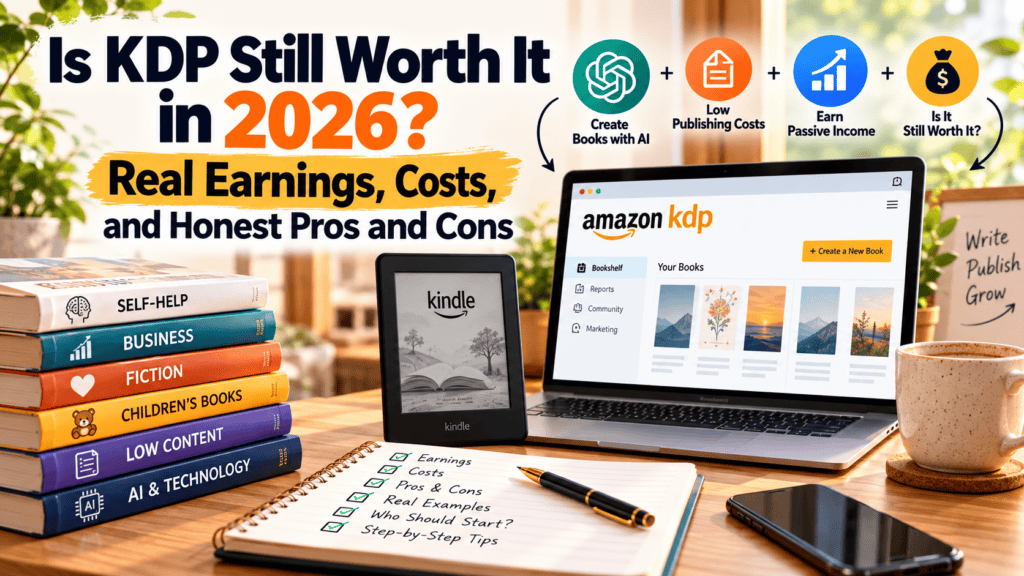
Is KDP worth it? Yes, it can still be worth it, but not for everyone. It works for people who treat publishing like a small business: they choose niches with real demand, invest in quality, and give each book time to build. It does not work as a get-rich-quick shortcut. Below is an honest breakdown of earnings, costs, risks and who should (and should not) start.
Table of Contents
- How KDP actually pays you
- How much can KDP authors really make?
- What it costs to publish on KDP
- Which niches still work
- Pros and cons
- Who should start (and who should skip it)
- How long does it take to see results?
- FAQ
How KDP Actually Pays You
KDP is free to join, and Amazon pays you a royalty each time a book sells or is read.
- Ebooks: a 35% or 70% royalty depending on your list price and territory. The 70% option applies within a set price range and deducts a small delivery fee based on file size.
- Paperbacks and hardcovers: a 60% royalty on the list price minus the printing cost, which depends on page count, trim size and ink type.
- Kindle Unlimited (KDP Select): you earn from pages read, in exchange for ebook exclusivity during enrollment.
Royalty rules and price ranges get updated, so confirm the latest numbers in KDP Help before you plan your pricing.
How Much Can KDP Authors Really Make?
Nobody can promise a fixed income, and be skeptical of anyone who does. Results range from a few dollars a month to a full-time income, and most of that spread comes from niche choice, book quality and marketing. To understand your own potential, run the math backward.
Illustrative royalty math
| Example | Price | Royalty rate | Approx. earnings per sale |
|---|---|---|---|
| Ebook (70% option) | $4.99 | 70% | About $3.49, minus a small delivery fee |
| Paperback | $14.99 | 60% minus print cost | About $9.00 minus print cost |
These are examples to show how the calculation works, not predictions. Your print cost and delivery fee will vary.
Simple goal-setting formula: Target monthly income divided by average royalty per sale equals the sales you need. If you want $1,000 a month and earn about $3 per sale, you need roughly 330 sales a month across your catalog. That is why most successful publishers build a library of books rather than rely on one title.
What I look at before putting money into a KDP book
I work as a KDP publishing strategist, handling niche selection, positioning, keywords, categories and ad scaling for investor-funded publishing projects. My approach is the same on every project: validate the niche before anything is written, make sure the cover and metadata match what shoppers in that niche expect, and scale ads only after a title shows it can attract readers on its own. Skipping those steps is the fastest way to turn a small test into an expensive one, which is why I treat the first book as a test and let the numbers decide what comes next.
What It Costs to Publish on KDP
Publishing is free, but a quality book is not. Typical expenses include:
- Writing or ghostwriting: your own time, or a paid writer.
- Editing and proofreading: essential for reviews and credibility.
- Cover design: one of the highest-impact spends you can make.
- Formatting: software or a formatter for clean ebook and print files.
- Research tools: optional keyword and BSR tools for niche validation.
- Advertising: Amazon Ads often becomes the biggest recurring cost once a book is live.
- Author copies and proofs: printed at cost for quality checks.
Budget for the first few books to break even slowly. Many beginners quit just before the compounding effect of reviews, ranking and a growing catalog kicks in.
Which Niches Still Work in 2026?
- Non-fiction how-to and self-help: readers pay to solve a specific problem, and focused sub-niches beat broad topics.
- Genre fiction series: romance, thrillers, fantasy and similar genres reward authors who publish consistently and keep readers in a series.
- Specialized professional and hobby guides: narrow audiences with high intent often face less competition.
- Low-content and activity books: still sold, but crowded and sensitive to quality and policy rules, so differentiation matters.
Whatever you choose, validate demand first. Our guide on choosing a profitable KDP niche shows how. For a quick shortlist to start from, grab the free guide 5 KDP Niches Still Worth Publishing In 2026.
Pros and Cons of KDP
Pros
- No upfront publishing fee and no inventory, since print on demand handles printing and shipping.
- Access to Amazon’s huge built-in audience.
- You keep your rights and control your pricing.
- Books keep earning long after you publish.
- Easy to scale by adding titles, formats and translations.
Cons
- Heavy competition in popular niches.
- Income is slow and uneven at the start.
- You depend on one platform whose rules and algorithms can change.
- Quality control and AI-disclosure rules mean shortcuts can backfire.
- Marketing and ads take real skill and money.
Who Should Start and Who Should Skip KDP
KDP is a good fit if you:
- Are willing to treat it as a long-term business.
- Can research a niche and improve based on data.
- Have expertise, a story, or the budget to hire people who do.
- Can publish consistently rather than once.
You might skip it if you:
- Need reliable income within the next few weeks.
- Expect passive income with no effort or spending.
- Plan to publish low-quality, copied or mass-produced books.
How Long Does It Take to See Results?
Most new publishers need several months and multiple titles before income becomes meaningful. A realistic path looks like this:
- Months 1 to 2: research, first manuscript and launch.
- Months 3 to 6: reviews, keyword and cover adjustments, small ad tests, a second and third title.
- Months 6 to 12: scaling what works and building a series or catalog.
Authors who treat the first book as a test and improve their process on the next ones tend to progress faster. If you want to shorten that curve, a KDP strategy and metadata service can help you avoid expensive early mistakes. If you would rather learn the process yourself first, the Make Passive Income with Amazon KDP Beginner Blueprint is a good starting point.
Frequently Asked Questions
Is Amazon KDP still profitable?
It can be, for publishers who choose demand-backed niches, produce quality books and market them well. Profitability varies widely, and there are no guaranteed results.
How much do Kindle authors make?
It ranges from almost nothing to full-time incomes. Earnings depend on your royalty rate, price, number of titles, niche, reviews and advertising.
Can you make passive income with KDP?
Books can earn over time without constant work, but getting there takes upfront effort, and most books still need updates, reviews and sometimes ads to keep selling.
How much money do I need to start on KDP?
You can publish for free if you do everything yourself, but a realistic budget for editing, a professional cover and some advertising makes your odds noticeably better.
Is KDP better than traditional publishing?
KDP offers faster launches, more control and higher royalty rates, while traditional publishing offers advances and distribution support. The better choice depends on your goals.
Is KDP Worth It? The Final Verdict
KDP is worth it if you approach it as a business with research, quality and patience. It is not worth it if you are chasing quick money. Start small, learn from the data, and grow your catalog one smart book at a time. When you are ready for expert support, talk to the KDP With AI team.