
Publishing a book on Amazon is only the beginning.
Once a potential reader discovers your book, they usually make a quick decision based on several important elements:
- The book cover
- The title
- The subtitle
- Reviews
- Price
- And the book description
Your Amazon KDP book description is one of the most important parts of your book’s sales page.
A strong description can help a reader understand why your book is relevant to them.
A weak description can cause them to leave—even if your book itself is excellent.
The goal of a book description is not simply to explain what your book contains.
Its purpose is to make the right reader want to take the next step.
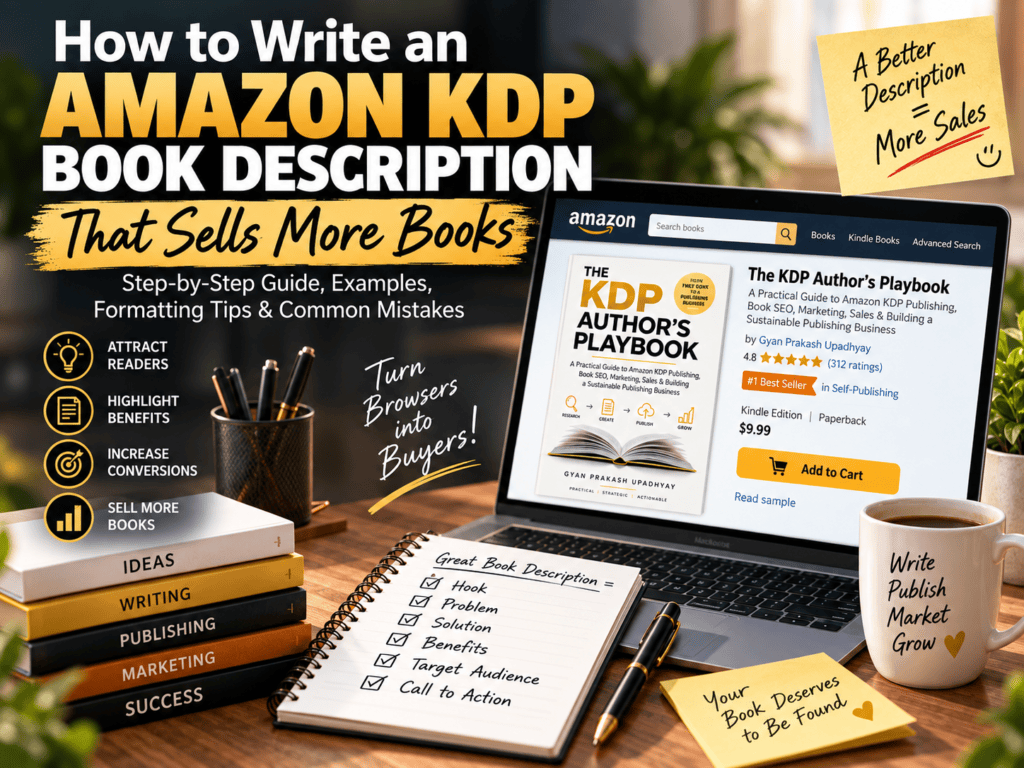
Table of Contents
What Is an Amazon KDP Book Description?
An Amazon KDP book description is the sales copy displayed on your book’s Amazon product page.
It gives potential readers more information about:
- What the book is about
- Who the book is for
- What problem it solves
- What readers can expect
- Why they should consider buying it
Think of your description as the bridge between:
Reader Interest → Purchase Decision
Your cover may attract attention.
Your title may communicate the topic.
But your description helps explain the value.
The Biggest Mistake Authors Make
One of the most common mistakes is writing a book description like a table of contents.
For example:
This book contains ten chapters about publishing, marketing, keywords, categories, book covers, and advertising.
There is nothing necessarily wrong with that information.
But it does not answer the most important question in the reader’s mind:
Why should I read this book?
A strong description focuses less on simply listing content and more on communicating benefits.
Instead of:
This book contains information about keyword research.
Try:
Learn how to research the words and phrases readers use when searching for books, so you can make better publishing and positioning decisions.
The topic remains the same.
But the value is clearer.
The Amazon KDP Book Description Formula
A simple structure can make writing easier.
Use this framework:
Hook → Problem → Solution → Benefits → Proof of Value → Call to Action
Let’s look at each section.
1. Start With a Strong Hook
The first few lines are extremely important.
Your opening should attract the attention of your target reader.
A nonfiction book can begin by identifying a problem.
For example:
Publishing a book on Amazon is easier than ever. Getting the right readers to discover it is the harder part.
This immediately introduces a relevant challenge.
Another example:
You can spend months writing a book and still struggle to generate sales if readers cannot understand why your book is relevant to them.
A fiction book may use a different approach.
For example:
She was supposed to inherit a kingdom. Instead, she inherited a curse that could destroy it.
The hook should create curiosity and encourage the reader to continue.
2. Identify the Reader’s Problem
After the hook, show that you understand the situation.
For a KDP guide, the reader may be struggling with:
- Choosing a book idea
- Finding keywords
- Selecting categories
- Writing metadata
- Marketing books
- Getting initial sales
You might write:
Many authors publish their books and then wait for Amazon to do the rest. Unfortunately, publishing alone does not guarantee discoverability.
This helps the reader recognize their own situation.
3. Present Your Book as the Solution
Now introduce the book.
Explain what it helps the reader achieve.
For example:
This practical guide provides a step-by-step framework for understanding the research, publishing, optimization, marketing, and growth stages of an Amazon KDP publishing business.
Keep the promise realistic.
Avoid exaggerated claims such as:
❌ Guaranteed bestseller
❌ Make thousands overnight
❌ Instant passive income
Instead, focus on genuine value.
4. Show Readers What They Will Learn
Bullet points work particularly well for nonfiction books.
For example:
Inside this book, you’ll learn how to:
✓ Research better book ideas
✓ Understand reader demand
✓ Find relevant Amazon KDP keywords
✓ Select appropriate categories
✓ Create stronger book metadata
✓ Improve book discoverability
✓ Develop a marketing strategy
✓ Build a growing publishing catalog
Each bullet should communicate value.
Avoid creating an unnecessarily long list.
Choose the benefits that are most important to your target reader.
5. Explain Who the Book Is For
This is often overlooked.
Tell readers directly whether the book is relevant to them.
For example:
This book is designed for aspiring authors, self-publishers, indie authors, and anyone who wants to understand how Amazon KDP works as part of a long-term publishing strategy.
A reader should be able to think:
Yes, this book is for me.
That clarity can be more effective than trying to appeal to everyone.
6. Create a Clear Call to Action
Your description should end by encouraging the reader to take the next step.
For example:
If you’re ready to move beyond simply uploading books and start building a more strategic publishing system, this guide will help you take the next step.
Simple.
Clear.
Relevant.
A Complete Amazon KDP Book Description Template
You can use the following structure for nonfiction books.
[OPENING HOOK]
Start with a statement, question, or problem that attracts your ideal reader.
Example:
Publishing a book is easier than ever. Building a system that helps readers discover it requires a different strategy.
[THE PROBLEM]
Explain the challenge.
Many authors spend months creating a book but give little attention to research, positioning, discoverability, and marketing.
[THE SOLUTION]
Introduce your book.
[Book Title] is a practical guide designed to help readers understand [main topic] and develop a clearer strategy for [desired outcome].
[BENEFITS]
Inside, you’ll learn how to:
✓ Benefit One
✓ Benefit Two
✓ Benefit Three
✓ Benefit Four
✓ Benefit Five
[TARGET READER]
This book is ideal for:
- [Audience One]
- [Audience Two]
- [Audience Three]
[CALL TO ACTION]
If you’re ready to [desired outcome], [Book Title] will help you take the next step.
How to Use Keywords in Your Book Description
Keywords are important for helping communicate the subject of your book.
However, your description should always be written for readers first.
Avoid keyword stuffing.
For example:
Amazon KDP publishing is the best Amazon KDP publishing guide for Amazon KDP publishing beginners who want to learn Amazon KDP publishing.
This sounds unnatural.
Instead, write naturally:
This guide helps aspiring authors understand Amazon KDP publishing, from book research and creation to discoverability, marketing, and long-term growth.
The topic is clear.
The wording is natural.
The reader experience remains the priority.
For a deeper guide on keyword research, you can also read:
[Amazon KDP Keyword Research: How to Find Keywords Readers Search For]
Formatting Can Improve Readability
Most people do not read an online product description word by word.
They scan.
This is why formatting matters.
Use:
- Short paragraphs
- Clear subheadings
- Bullet points
- Bold text where appropriate
- White space
Avoid publishing one large block of text.
A well-structured description makes it easier for readers to understand your book quickly.
Book Description Example: The KDP Author’s Playbook
Here is an example based on a practical publishing guide.
Publish Smarter. Reach More Readers. Build a Real Publishing Business.
Amazon KDP has made it easier than ever to publish a book. But publishing a book and building a sustainable publishing business are two very different things.
Many authors focus on writing and uploading their books, then wonder why readers are not finding them.
The missing piece is often a system.
The KDP Author’s Playbook provides a practical framework for understanding the complete publishing journey—from researching book ideas and keywords to publishing, discoverability, marketing, advertising, and long-term catalog growth.
Inside, you’ll learn how to:
✓ Research book ideas and reader demand
✓ Find relevant Amazon KDP keywords
✓ Choose appropriate book categories
✓ Analyze competition and positioning
✓ Create professional books and metadata
✓ Improve discoverability with better KDP SEO
✓ Develop a book marketing strategy
✓ Understand Amazon advertising
✓ Build a stronger publishing catalog
✓ Create repeatable publishing systems
This book is designed for aspiring authors, self-publishers, indie publishers, and anyone who wants to approach Amazon KDP more strategically.
One book can be a project. A catalog can be an asset. A system can become a business.
Get The KDP Author’s Playbook
If you want a deeper, step-by-step guide to building a more strategic Amazon KDP publishing system, you can explore:
The KDP Author’s Playbook
Get The KDP Author’s Playbook on Amazon
The book covers the broader publishing journey, including research, keywords, categories, book SEO, marketing, advertising, AI tools, and long-term catalog growth.
Common Amazon KDP Book Description Mistakes
1. Starting With a Long Introduction
Readers should understand the book’s value quickly.
Avoid spending several paragraphs on background information before explaining why the book matters.
2. Listing Chapters Instead of Benefits
A chapter list explains what is inside.
Benefits explain why it matters.
Focus on both—but prioritize reader value.
3. Trying to Appeal to Everyone
A book written for everyone often feels relevant to no one.
Be specific about your target audience.
4. Making Unrealistic Promises
Trust matters.
Avoid claims you cannot support.
Clear and realistic promises can build more credibility.
5. Forgetting the Call to Action
Your description should guide the reader toward a decision.
End with a clear reason to take the next step.
Final Thoughts
A good Amazon KDP book description does not need complicated copywriting tricks.
It needs clarity.
The reader should quickly understand:
What is this book about?
Is it relevant to me?
What will I gain from reading it?
Why should I choose this book?
When your book description answers those questions clearly, it can become a much stronger part of your Amazon listing.
Remember this formula:
Hook → Problem → Solution → Benefits → Reader → Call to Action
Use it as a starting point.
Then adapt it to your book, audience, and genre.
Your book description may only take a few minutes to read—but it can play an important role in helping the right reader decide to buy.