
How to Build a Successful Amazon KDP Publishing Business
Amazon KDP has made it possible for almost anyone to publish a book and reach readers around the world.
But there is a major difference between publishing a book and building a publishing business.
Many beginners follow this pattern:
Write one book → Publish it → Wait for sales.
Unfortunately, this approach often leads to disappointment.
A sustainable Amazon KDP publishing business requires a more strategic process.
You need to understand:
- What readers are searching for
- Which book ideas have market potential
- How to research keywords
- How to select relevant categories
- How to create a professional book
- How to optimize your Amazon listing
- How to market your book
- How to measure results
- How to build a catalog over time
The good news is that you don’t need to master everything at once.
You need a repeatable publishing system.
The KDP Publishing Business Model
A successful self-publishing business can be understood through a simple process:
Research → Create → Publish → Market → Measure → Improve → Scale
Each stage affects the next.
For example, poor research can lead to a book idea with limited reader demand.
A weak cover can reduce clicks.
Poor keywords can limit discoverability.
An unclear description can reduce conversions.
And publishing without marketing can make it difficult for potential readers to discover your book.
This is why successful self-publishers do not treat publishing as a single event.
They treat it as a system.
Step 1: Research Before Writing
One of the biggest mistakes new authors make is writing a complete book before checking whether readers are interested in the topic.
Before you begin writing, research:
Reader Demand
Ask yourself:
- Are people actively searching for this topic?
- Are similar books being published?
- Does the topic solve a problem?
- Can the topic attract a specific audience?
Competition
Competition is not always a bad sign.
If other books are selling, it can indicate that readers exist.
The important question is:
Can you create a book with a clearer angle, better structure, stronger design, or more useful information?
Keywords
Keywords help you understand how readers search for information and books.
For a detailed guide, read:
Long-tail keywords can be particularly useful because they often represent more specific reader intent.
Step 2: Choose the Right Book Categories
Categories help position your book in front of relevant readers.
Think of them as the shelves where your book belongs.
Choosing a category simply because it looks easy to rank in is not a good long-term strategy.
The category should match:
- Your actual content
- Your target reader
- Reader expectations
- Your book’s positioning
You can read our complete guide here:
Amazon KDP Categories Explained: How to Choose the Right Categories
Categories and keywords work together to improve discoverability and help readers understand what your book is about.
Step 3: Create a Book Readers Actually Want
Publishing technology has made it easier to create books.
But readers still expect quality.
Your book should have:
- A clear purpose
- A defined target audience
- A logical structure
- Useful information or entertainment
- Professional editing
- Consistent formatting
- A strong cover
The goal should not be to publish as quickly as possible.
The goal should be to create something that a reader feels was worth buying.
This is especially important for nonfiction books, where readers are usually purchasing a promised outcome, answer, skill, or solution.
Step 4: Optimize Your Book for Amazon Search
Amazon is also a search platform.
Readers search for books using phrases related to their interests and problems.
Your book listing should clearly communicate:
- What the book is about
- Who it is for
- What the reader will learn or experience
- Why the book is relevant
Important elements include:
Book Title
Your title should be memorable and relevant.
Subtitle
A subtitle can provide additional clarity and communicate the value of the book.
Keywords
Relevant keyword phrases help Amazon understand the topic and context of your book.
Categories
Categories help position the book within Amazon’s browsing structure.
Book Description
The description should persuade a potential reader to take the next step.
For a complete guide, read:
Amazon KDP SEO: How to Rank Your Books Higher on Amazon
Amazon KDP SEO involves aligning keywords, categories, metadata, descriptions, and marketing so the book is easier for relevant readers to discover.
Step 5: Don’t Depend on One Book
One of the most important mindset shifts for self-publishers is this:
One book can be a project. A catalog can become an asset.
A single book may perform well.
Or it may take time to gain traction.
But a growing catalog gives you more opportunities to:
- Reach different readers
- Rank for more search terms
- Create cross-selling opportunities
- Build your author brand
- Test different topics
- Generate multiple revenue sources
This is why many serious KDP publishers focus on building a catalog rather than waiting for one book to become a bestseller.
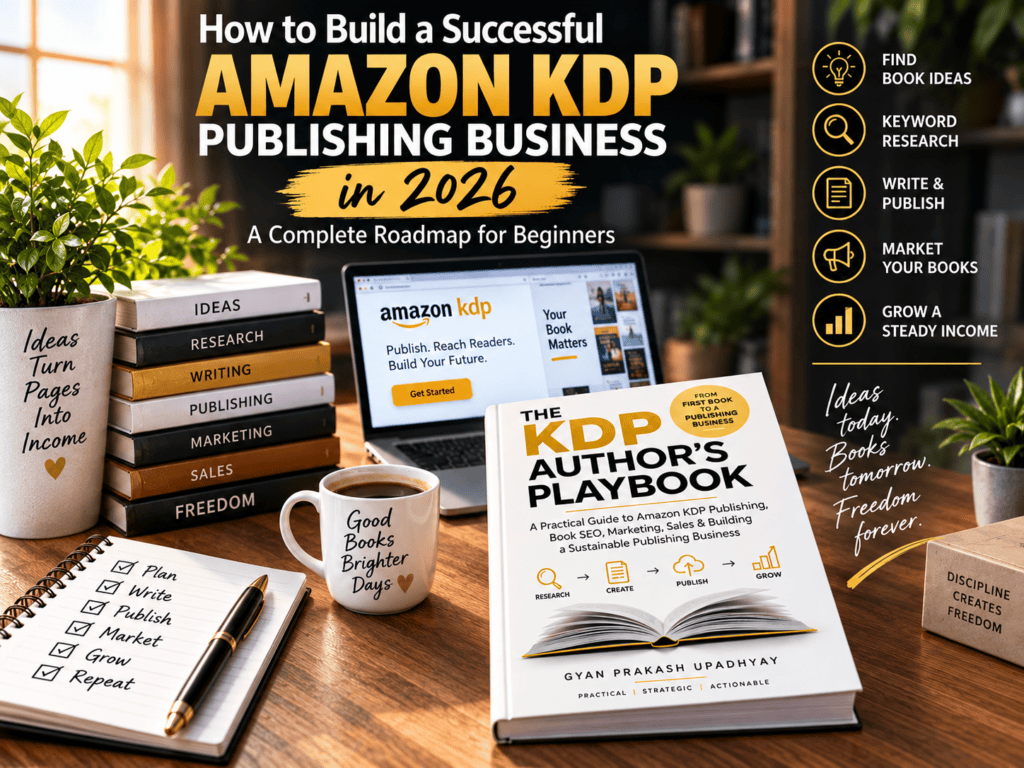
The KDP Author’s Playbook: A Complete Publishing Framework
If you want a deeper, step-by-step framework for building an Amazon KDP publishing business, I created:
The KDP Author’s Playbook
The book is designed for aspiring authors, self-publishers, and indie publishers who want to understand the complete publishing journey.
Inside, you will learn about:
✓ Choosing and researching book ideas
✓ Amazon KDP keyword research
✓ Category selection
✓ Competition analysis
✓ Book planning and creation
✓ Professional book formatting
✓ Amazon KDP SEO
✓ Book titles and descriptions
✓ Pricing and royalties
✓ First book sales
✓ Amazon Ads
✓ Author marketing
✓ AI tools for KDP authors
✓ Building a publishing catalog
✓ Creating repeatable publishing systems
✓ Long-term publishing strategy
Instead of treating KDP as simply a place to upload books, the book focuses on building a complete publishing process.
Get Your Copy
Buy The KDP Author’s Playbook on Amazon
Step 6: Use Marketing to Create Discoverability
Publishing a book does not automatically mean readers will find it.
You need to create multiple paths that can bring readers to your Amazon book page.
These can include:
Your Website
Articles can attract readers from Google and introduce your book as a deeper solution.
Create pins around:
- Amazon KDP tips
- Book publishing checklists
- Keyword research
- Self-publishing mistakes
- KDP business strategies
Each pin can lead to a relevant article on your website.
The article can then introduce your book.
Share insights about publishing, self-publishing, and building digital assets.
YouTube
Create educational videos around individual KDP topics.
Build an audience that is interested in publishing and self-publishing.
The most effective strategy is often not sending everyone directly to a book listing.
Instead, provide useful content first.
Then introduce the book as the next logical step.
Step 7: Use AI to Improve Your Publishing Workflow
AI can help authors work faster.
It can assist with:
- Brainstorming
- Book outlines
- Draft development
- Editing support
- Marketing ideas
- Content planning
- Research organization
However, AI output should not replace careful human review.
Quality, accuracy, originality, and reader value still matter.
For a detailed breakdown, read:
Best AI Writing Tools for KDP Authors
Your existing AI tools guide also emphasizes using AI strategically for outlining, drafting, editing, research, and marketing rather than publishing raw output without review.
Step 8: Measure What Is Actually Working
Don’t make decisions based only on assumptions.
Track:
- Book sales
- Royalties
- Advertising spending
- Advertising sales
- Website traffic
- Article rankings
- Click-through rates
- Conversion performance
- Best-performing topics
Over time, data can help answer important questions:
Which book topics attract readers?
Which articles generate clicks?
Which keywords produce traffic?
Which marketing channels are worth continuing?
The goal is to spend more time and resources on strategies that show evidence of working.
Your 90-Day Amazon KDP Action Plan
Month 1: Build the Foundation
Focus on:
- Researching your niche
- Choosing a book idea
- Researching keywords
- Studying categories
- Creating an outline
Month 2: Create and Publish
Focus on:
- Completing the manuscript
- Editing
- Formatting
- Cover design
- Metadata optimization
- Publishing
Month 3: Generate Discoverability
Focus on:
- Website content
- Amazon Ads
- Author platform development
- Reader outreach
- Performance tracking
At the end of 90 days, review your results.
Then improve your system.
Final Thoughts
Amazon KDP can provide an opportunity to build a long-term publishing business.
But the strongest results usually come from combining multiple skills.
You need research.
You need quality.
You need positioning.
You need discoverability.
You need marketing.
And you need patience.
The goal should not be to chase a single trick that generates instant sales.
The goal should be to build a publishing system that improves with every book.
Research → Create → Publish → Market → Measure → Improve → Scale
That is how individual books can eventually become a publishing catalog.
And how a publishing catalog can become a long-term business.
Ready to Build Your KDP Publishing System?
If you want the complete step-by-step framework covering research, book creation, Amazon KDP SEO, marketing, advertising, AI tools, catalog building, and long-term publishing strategy, get your copy of:
The KDP Author’s Playbook
Get The KDP Author’s Playbook on Amazon
One book can be a project. A catalog can be an asset. A system can become a business.