
Amazon KDP categories help authors position their books in the right sections of the Amazon Kindle and book marketplace. Choosing relevant categories can make it easier for the right readers to discover your book and can support your overall Amazon KDP publishing strategy.
But choosing categories is not simply about finding the least competitive option. Your categories should accurately represent your book, match reader expectations, and work alongside your keywords, title, subtitle, and book description.
In this guide, you’ll learn how Amazon KDP categories work, how to research potential categories, how to choose relevant options, common mistakes to avoid, and how categories fit into a broader KDP SEO strategy.
Categories work best when they are considered alongside your keyword strategy. Read our Amazon KDP Keyword Research guide to learn how to identify relevant search terms.
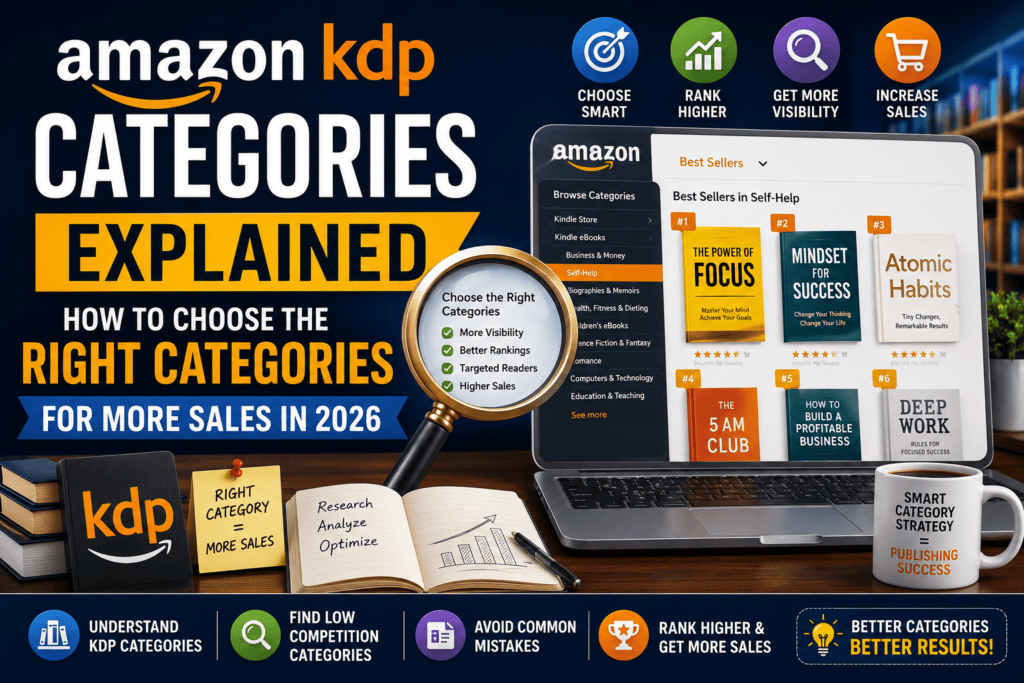
What Are Amazon KDP Categories?
Amazon KDP categories are the sections and genres where your book is listed on Amazon.
Think of categories as virtual bookstore shelves.
For example:
- Business & Money
- Self-Help
- Science Fiction
- Fantasy
- Children’s Books
- Technology
When readers browse Amazon by category, your book can appear alongside similar titles.
Choosing relevant categories helps Amazon understand your book and recommend it to the right audience.
Why Amazon KDP Categories Matter
Many authors underestimate the importance of category selection.
The right categories can:
- Increase book visibility
- Improve Amazon rankings
- Help achieve Bestseller status
- Attract targeted readers
- Increase organic sales
The wrong categories can place your book in highly competitive markets where it becomes almost impossible to get noticed.
Category selection is only one part of getting readers. Our guide on How to Get Your First 100 Book Sales on Amazon KDP covers additional promotion strategies.
Categories vs Keywords: What’s the Difference?
Many new authors confuse categories and keywords.
Categories
Categories tell Amazon where your book belongs.
Example:
- Business & Money
- Personal Finance
- Entrepreneurship
Keywords
Keywords tell Amazon what readers may search for.
Example:
- amazon kdp publishing
- passive income books
- self publishing guide
Both categories and keywords work together to improve discoverability.
For a complete keyword optimization strategy, check out our Amazon KDP Keyword Research guide.
Your categories and keywords should support the same overall book positioning. Learn more in our Amazon KDP SEO guide.
How Amazon Uses Categories
Amazon uses categories to:
- Organize books
- Display bestseller lists
- Recommend books
- Improve search results
When your category matches reader intent, Amazon is more likely to show your book to potential buyers.
This is why category selection directly impacts visibility.
How Many Categories Can You Choose?
Amazon allows authors to choose primary categories during publishing.
Over time, Amazon has adjusted category systems and visibility, but the core principle remains the same:
Choose the most relevant categories possible.
Avoid selecting categories simply because they seem less competitive.
Relevance always comes first.
How to Choose Amazon KDP Categories
Iske andar practical process do:
Step 1: Identify Your Book’s Primary Topic
Step 2: Identify Your Target Reader
Step 3: Research Similar Books
Step 4: Compare Relevant Categories
Step 5: Check Competition
Step 6: Select Categories That Accurately Describe Your Book
Step 7: Review Your Categories After Publishing
How to Find the Best Amazon KDP Categories
1. Analyze Top-Selling Books
Search for books similar to yours.
Study:
- Their categories
- Their rankings
- Their positioning
Top-performing books often reveal valuable category opportunities.
2. Browse Amazon Category Trees
Visit Amazon and browse category sections manually.
Look for:
- Relevant niches
- Subcategories
- Specialized audiences
Often the best opportunities are found several levels deep.
Example:
Business & Money → Entrepreneurship → Small Business
This is often easier to rank in than broad Business categories.
3. Focus on Reader Intent
Ask yourself:
“What would my ideal reader browse to find this book?”
If your book is about productivity, don’t place it in a broad business category just because it’s popular.
Choose the category that best matches reader expectations.
Low-Competition Category Strategy
Many successful self-published authors use a low-competition category strategy.
Instead of targeting broad categories like:
- Self Help
- Business
- Fiction
They target more specific categories such as:
- Time Management
- Personal Success
- Small Business Entrepreneurship
- Writing Skills
- Artificial Intelligence
Smaller categories often provide better visibility.
Best Categories for Business Books
Business books continue to perform strongly on Amazon.
Popular categories include:
- Entrepreneurship
- Marketing
- Leadership
- Sales
- Small Business
If you’re publishing books related to Amazon KDP, self-publishing, or online income, entrepreneurship categories may be highly relevant.
Best Categories for Finance Books
Finance remains one of Amazon’s strongest nonfiction niches.
Popular categories include:
- Investing
- Personal Finance
- Wealth Management
- Financial Freedom
- Budgeting
Authors should select categories that closely match the financial topic being covered.
Best Categories for AI and Technology Books
Technology books are growing rapidly in popularity.
Recommended categories include:
- Artificial Intelligence
- Computer Technology
- Programming
- Digital Transformation
- Emerging Technologies
These categories are especially relevant for books about ChatGPT, AI tools, automation, and prompt engineering.
Best Categories for Children’s Books
Children’s books have unique category structures.
Popular choices include:
- Activity Books
- Coloring Books
- Early Learning
- Educational Books
- Bedtime Stories
Always choose age-appropriate categories for better targeting.
Best Categories for Journals and Low-Content Books
For journals, planners, and workbooks:
- Personal Growth
- Productivity
- Wellness
- Organization
- Goal Setting
The category should align with the purpose of the journal rather than simply labeling it as a notebook.
Best Categories for Self-Help Books
Popular self-help categories include:
- Personal Transformation
- Motivation
- Time Management
- Productivity
- Success
Books focused on habits, discipline, and mindset often perform well in these niches.
Common Category Selection Mistakes
Choosing Irrelevant Categories
Never choose categories that don’t match your content.
This may hurt conversion rates and reader satisfaction.
Chasing Bestseller Badges Only
Some authors choose categories solely because they seem easy to rank in.
While ranking matters, relevance matters more.
A bestseller badge won’t help if readers aren’t interested in your topic.
Ignoring Competitor Research
Competitor analysis is one of the easiest ways to identify effective category opportunities.
Always study successful books in your niche.
Never Updating Categories
Markets evolve.
Reader interests change.
Review your categories periodically to ensure they remain relevant.
How Categories Impact Bestseller Rankings
Amazon calculates rankings within categories.
The smaller and more targeted the category, the easier it can be to rank higher.
For example:
Ranking #20 in a broad category may be difficult.
Ranking #1 in a specialized subcategory may be much easier.
This is one reason category optimization can have a major impact on visibility.
Categories and Amazon KDP SEO
Categories are an important part of Amazon KDP SEO.
However, categories alone won’t guarantee rankings.
You also need:
- Strong keywords
- Optimized titles
- Effective descriptions
- Professional covers
- Positive reviews
When combined, these elements create a powerful optimization strategy.
If you need help optimizing your listings, explore our Amazon KDP SEO Services.
How Often Should You Review Categories?
A good rule is to review categories:
- Before launch
- After launch
- Every few months
You should also reassess categories whenever:
- Sales decline
- New competitors emerge
- Amazon updates category structures
Regular reviews help maintain visibility.
Amazon KDP Category Selection Checklist
| Factor | What to Check |
|---|---|
| Relevance | Does the category accurately describe your book? |
| Reader Intent | Would your target reader browse this category? |
| Competition | How competitive are similar books? |
| Specificity | Is there a more relevant subcategory? |
| Book Positioning | Does it fit your overall marketing strategy? |
| Long-Term Fit | Will the category remain relevant to your book? |
If you’re new to KDP, start with our complete guide on How to Publish on Amazon KDP.
Final Thoughts
Amazon KDP categories are one of the most overlooked yet powerful tools available to self-published authors.
The right category strategy can improve discoverability, help your book reach the right readers, and increase your chances of generating consistent sales.
Instead of selecting categories randomly, invest time in researching competitors, understanding reader intent, and identifying relevant low-competition opportunities.
Combined with strong keyword research and effective marketing, category optimization can become a major contributor to your publishing success.
Whether you’re publishing your first book or managing a growing catalog, mastering Amazon KDP categories is an essential step toward long-term success on Amazon.
Pingback: How to Get Your First 100 Book Sales on Amazon KDP (Proven Strategy for 2026)
Pingback: How to Build a Successful Amazon KDP Publishing Business in 2026